Advice
What does a carpenter cost per hour?
An hourly rate tells you little about what your job costs. Small and unpredictable carpentry goes by the hour, made-to-measure work goes by the job. With made-to-measure work you pay for four things: the materials and the ironmongery, the measuring up and the drawing, the hours that go into the making itself, and the fitting at your place. The figure at the bottom is rate times hours, and that second number is the one hardly anyone names beforehand.
Updated 2026-09-02
“What does a carpenter cost per hour” is one of the first things people look up, and at the same time the figure that helps you least. An hourly rate tells you nothing about what your job costs. That depends on the number of hours, on what is in that rate, and above all on whether this work should be going by the hour at all. With carpentry and fitting part of the work goes by the hour and part by the job, and that distinction decides your bill more than the rate itself.
When carpentry goes by the hour
I work by the hour when there is no way to see beforehand how much time something takes. That sounds like hedging, but it is meant the other way round. If I gave a fixed price for that kind of work, I would build a margin for the worst case into it, and you would pay that margin as well when it turns out fine.
Think of a door that sticks and where you only see why once it is off its hinges. A skirting board coming away because the surface behind it is no good any more. A cupboard door hanging crooked, a threshold due for replacement, or that list of small things that piles up in a house. That work falls under odd jobs and maintenance, and there charging hours is the fairest form.
The same goes for stripping out and repair work in an older house. As long as a floor or a wall is closed up, nobody knows what sits behind it. I would rather give an estimate of the number of hours, with the reason next to it why it could turn out more or less, than a fixed figure that suggests a certainty that is not there yet.
When it goes by the job
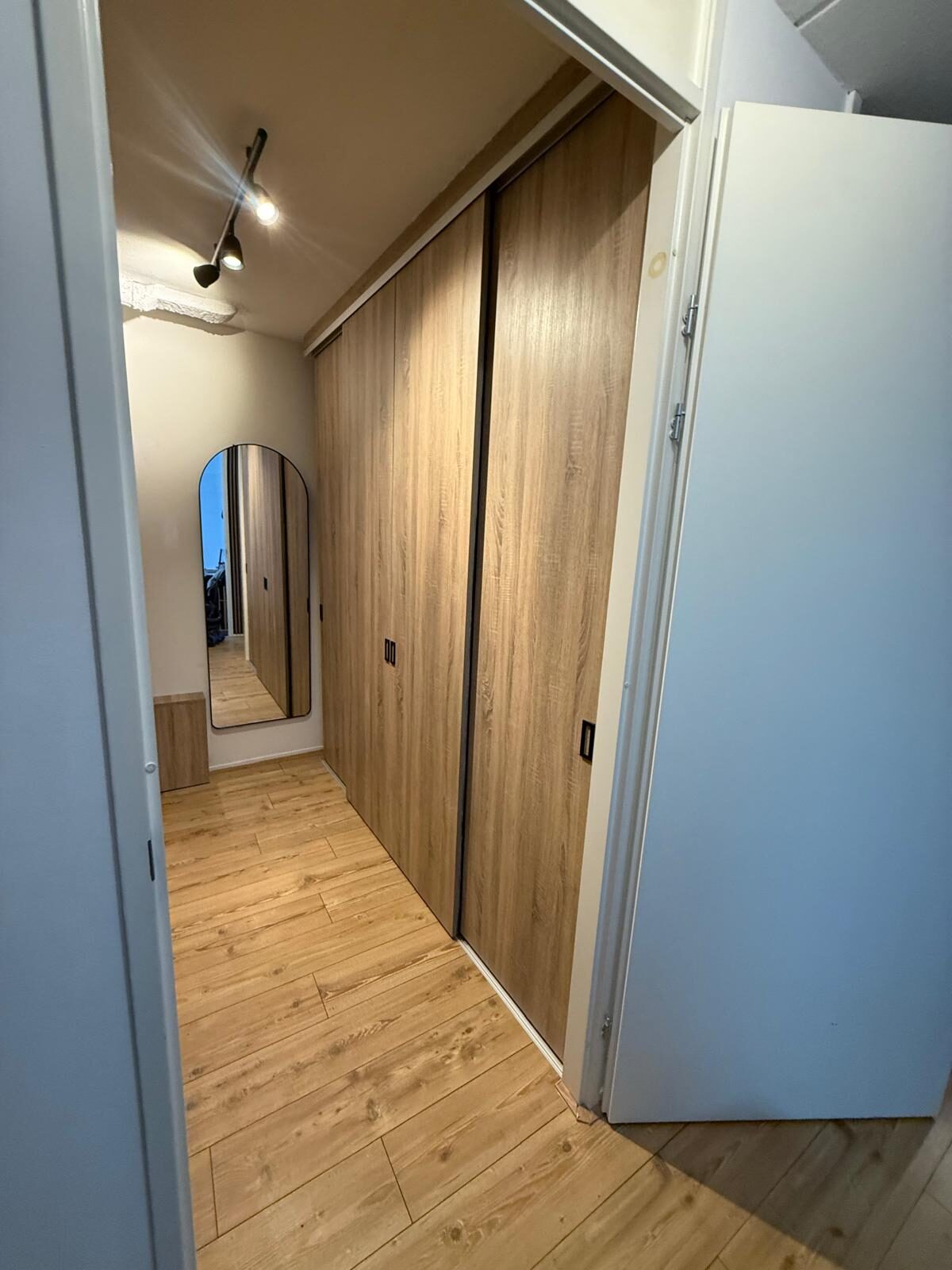
As soon as a drawing comes into it, the work goes by the job. A walk-in wardrobe, a cupboard in an alcove, a run of doors under a sloping roof, a built-in bench or a wall of bookshelves are not hours. They are something I draw for your room, make to measure and fit at your place.
A fixed price is in your favour on that work too. The risk that it takes longer than estimated then sits with me. If I work slower than I thought, that is my problem and not your bill. With an hourly rate it is the other way round, and then you are helping to pay for my puzzling over your out-of-true wall.
There is one more reason. Hourly rates cannot be compared. Two rates side by side say nothing as long as you do not know how many hours belong with them, and hardly anyone names that number beforehand. Two fixed prices for the same cupboard you can compare, at least if both of them say what you get.
What sits in the price of a cupboard made to measure
With made-to-measure work you pay for four things, and only one of them is visible once the cupboard is standing there.
Materials. The board material and the finish, but above all the ironmongery: the hinges, the drawer runners, the hanging systems. That is where the difference sits between a door that still closes neatly years later and a door that starts to drop before long. Ironmongery is the item that is easiest to save on and the one you as a customer notice last.
Measuring up and drawing. I measure the room, draw the cupboard and turn that into a materials list and a cutting plan. Those are hours you see nowhere, and they are exactly the hours that decide whether it fits later on. In an existing house there is hardly a wall that is straight or a floor that is level. A cupboard that adds up on paper but has been drawn on square corners does not close up against anything in real life.
The making itself. Sawing, drilling, prepping and cutting to fit happens largely before I come through your door, not in your room. That saves you dust and disruption, and it is the reason the fitting at your place stays short. Those hours are in the price, even though you never see me making them.
Fitting. Levelling on a floor that is not flat, scribing in against a wall that runs out, closing up the joints, cutting skirtings and trims to fit. This is where made-to-measure work proves itself and where the time goes. On top of that comes what nobody expects on a quote: getting the parts there, taking away offcuts and packaging, and the time to leave your house the way I found it. How a cupboard like that comes about in practice is on a walk-in wardrobe made to measure.
What to watch for with a low hourly rate
If someone names a rate that is noticeably low, ask three questions before you get happy about it.
What is in it? Travelling time, fetching materials, tools and machines, taking the waste away and VAT are items that are either in it or come on top separately. A low rate with nothing in it works out higher than a higher rate with everything in it.
How is it counted? By the quarter hour or by every hour started, from your front door or from the van, with or without a minimum charge. Those stop being details as soon as the work runs to a few days.
And how many hours will it be? The figure at the bottom is rate times hours. Someone who is quick to name a low rate but will not say how many hours he thinks he needs has told you nothing yet. On bigger jobs the carpentry also runs over into other work, such as a floor that has to be level first or a renovation where the carpentry is only one part. So ask as well who stops where, because that is where the gaps between two quotes come from.
How I go about it myself
At the first visit I say which of the two it is going to be. Small and unpredictable work goes by the hour, with an estimate of the hours and the reason why it could come out differently. Made-to-measure work goes by the job, with a fixed price after I have measured up, and with a quote that says what I supply and what is not in it.
I work on my own and stand on the job myself, so you do not get an estimator on the phone and somebody else on the floor. That is sometimes a drawback, because I can only be in one place at a time. The advantage is that the man who draws the cupboard also makes it and hangs it, and that there is nobody to point at when a measurement is out. All the carpentry and fitting work I do goes that way.
Featured work
The proof is in and around the house.
Frequently asked questions
Why is there no hourly rate on this page?
Because a rate without the number of hours next to it is not information, and the number of hours depends on what has to happen at your place. I would rather first say whether your job should go by the hour or by the job, because that difference decides more than the rate does. After that I name a figure that means something.
When do you work by the hour and when for a fixed price?
By the hour on work where there is no way to see beforehand how much time it takes, such as a door that sticks or repair work whose size you only see once it is open. For a fixed price on everything that involves a drawing and a materials list, so on made-to-measure work. I say at the first appointment which of the two it is.
Is by the hour cheaper than a fixed price?
On small work often yes, because then you pay only the hours that really go into it and there is no margin for setbacks in it. On made-to-measure work it is the other way round. There an hourly rate puts all the uncertainty with you, and you only know afterwards what it has come to.
Do I pay separately for the measuring up and the drawing?
In a fixed price for made-to-measure work those hours are already in there, so they do not appear as a separate line on your bill. They are there all the same, and they weigh heavier than people think, because the drawing decides whether the cupboard really closes up in an existing house with walls that are out of true. Ask on every quote whether measuring up and drawing are included, because that is not the case everywhere.
Why does a cupboard made to measure cost more than one from a shop?
Because with a cupboard from a shop you buy a box, and with made-to-measure work you buy a solution for your room. The difference sits in the measuring up, the drawing, the making and above all the fitting: scribing in against a wall that runs out and levelling on a floor that is not flat. A standard cupboard you push against the wall, and then you see the gap.
What do I ask someone who only names an hourly rate?
Three things. What is in that rate, so travelling time, fetching materials, tools, taking the waste away and VAT. How it is counted, by the quarter hour or by every hour started, and whether there is a minimum charge. And how many hours he thinks he needs. If that last answer does not come, you still do not know what your job costs.
Have this done for you
Would you rather have this work carried out than read about it? Here is what I do exactly.