Services
Facade cladding: wood, composite, plastic or brick slips
New exterior facade cladding in wood, composite, plastic or brick slips, on a batten frame that lets the wall breathe.
Facade cladding is a second skin over the wall you already have. Boards or panels on a batten frame, with a ventilated cavity in between. It decides how your house looks, it keeps driving rain off the brickwork and you can fit insulation behind it. Choosing between the materials is mostly a choice about maintenance: wood asks for attention, composite and plastic ask far less, and brick slips ask almost nothing afterwards but the most while they go on.
What I do for you
I work in Nieuwegein and Utrecht, and for a bigger job further out into the region.
How I go about it
- Wood, composite, plastic or brick slips, with the difference in maintenance named honestly
- Batten frame, breather membrane and a ventilated cavity, because that is where the lifespan sits
- Junctions around window frames, dormer, roof edge and downpipe finished neatly
- Renovation of existing cladding that is worn out or has come loose
- On a commercial building or a restaurant too, around the opening hours if that is needed
- Insulation taken along behind the cladding, while the wall is open anyway
Facade cladding is a second skin over your wall. Boards or panels on a batten frame, with air in between, fixed to the brickwork or the timber that is already standing there. It changes the look of your house more than anything else on the outside, it keeps the rain off the wall, and while that wall is open anyway you can fit insulation behind it.
What it is not: a cure for damp or cracks. Those take no notice of a panel in front of them. They only become invisible, and that is exactly what you do not want. If something is wrong behind the wall, I sort that first and only then does the cladding go over it.
Most people who end up here are still comparing, not ringing. That is why the material comes first on this page and the quote comes last. It does me no good if you regret your choice in a few years.
Why people choose exterior facade cladding
Roughly three reasons, usually mixed together.
Looks. A dated facade turns into a different house. That is the reason most people name first and then half apologise for. No need, it is a perfectly good reason.
Protection. Driving rain in the Netherlands comes mostly out of the south-west, and that one wall always takes more than the rest. Cladding catches it, and the cavity behind drains off whatever still gets through.
Insulation. If you are screwing a batten frame onto the wall anyway, the space between those battens is the cheapest insulation you will ever fit. Do not do it right away and you never will, because then the cladding has to come off again.
Wood
Wood is the material people fall in love with and then spend the longest negotiating with themselves about. Fair enough, because it is the only material in this list that is alive.
Untreated wood weathers grey. That is not a fault, that is wood, and on a modern facade it can be beautiful. Only it does not go grey evenly. The side that catches sun and rain moves faster than the piece under an overhang, and you see that difference. If you want to keep the colour, you are looking at a treatment you repeat at some interval. How often depends on the species, the colour and how hard that wall gets it, so I say that only once I have seen it.
Wood also moves. It expands and shrinks with the weather, and that is why fitting it differs from fitting a panel: room to move, fixings that allow it, end grain that does not stand in water. Get that wrong and after the first wet winter you see twisted boards and screw holes splitting.
The full weighing up between species, profiles and finish sits on the page about wood facade cladding.
Composite
Composite is wood fibre mixed with plastic, pressed into boards that look like wood without being wood. It is meant for anyone who wants the warm look and not the maintenance.
That mostly holds true. No painting, no oiling, and the colour stays put far better than on painted wood. But there are two things you rarely read first in the brochure. Composite carries on colouring slightly at the start, so do not buy too tight and keep a few boards back in case one ever has to be replaced. And composite expands a lot in the sun, which means the joints and the fixings have to allow that movement. A composite facade pushed tight shut will bow at the first real heat.
The material is heavier than wood and most systems are tied to one brand, so profiles, clips and corner trims come out of the same range. What that means for choosing and fitting sits on the page about composite facade cladding.
Plastic
Plastic facade cladding is one of the lowest maintenance options of the four. Weatherboards or panels in PVC, usually with a click system, that you keep clean with water and a brush and otherwise leave alone. No painting, no oil, no greying.
With this material you often hear a brand name instead of a material. There are several manufacturers making comparable click systems. I do not sell systems and I hold no dealership, so I look with you at what suits the wall and what is available.
Honest about the downside: up close plastic looks like plastic. On a dormer, a gable or a fascia board you hardly notice, on a whole front wall at eye level you do. Plastic expands with heat as well, so here too the fixing has to allow movement. And a deep scratch or a cracked board is not something you touch up, that board comes out.
Brick slips
Brick slips are thin slices of brick or ceramic that you bond onto an insulation board or straight onto the wall and then point. The result is brickwork to look at, without a new wall having been built.
This is the option for anyone who wants a facade that still looks exactly the same years from now. Maintenance is practically nil, beyond keeping an eye on the pointing. The price here sits not in the material but in the hours: bonding, setting the slips, pointing, and all of it inside the temperature range where adhesive and pointing mortar may be worked. In a frost that work stops, and that is a planning question you would rather know beforehand than halfway through.
Brick slips combine well with external wall insulation, and then it is at once the heaviest of the four to carry out. The wall gets thicker, the window frames sit deeper, and the roof edge and the rainwater downpipe have to come along.
Maintenance and lifespan side by side
Short version, without pretty promises.
Wood asks the most and gives the most back. Composite and plastic ask little, but what breaks you replace instead of repair. Brick slips ask almost nothing once they sit right, but a mistake made while fitting stays visible: a repair in brickwork always shows.
And the same holds for all four. The lifespan of a facade is not decided by the material on the outside, but by what sits behind it. A timber facade on a well ventilated batten frame lasts longer than a plastic facade screwed tight against wet brickwork.
What sits behind the cladding
This is the part to watch when you compare quotes, precisely because you never see it again.
Onto the wall goes a batten frame, vertical or horizontal depending on the direction of the cladding. Between those sits the cavity where air has to be able to travel from the bottom upward, or the back of your cladding never dries. At the bottom a mesh against vermin, behind the battens a breather membrane, and at every window frame, every corner and every junction a trim that leads the water out instead of in.
Those junctions are the real work. A flat wall almost clads itself. It is the window frames, the dormer, the vents and the transition to the roof where the hours go. If the cladding runs up under the roof edge, I take on the fascia board and the roof edge at the same time, because doing those two separately means paying for scaffolding twice.
Fitting cladding to an existing wall
Cladding renovation comes in two flavours. Old cladding that is finished, usually painted wood that waited too long for maintenance. Or a bare wall that has never been clad and whose owner has had enough of the look of it.
Either way it starts at the substrate. The old cladding comes off, I look at what is under it, and I tell you honestly whether that carries a new batten frame. Sometimes that is an unwelcome conversation, because putting right a rotted timber substructure soon costs more than the new cladding itself.
Bear in mind as well that the wall gets thicker. Your window frames sit deeper, which usually looks better, but the roof overhang, the window sills and the rainwater downpipe have to come along in that dimension. If the cladding runs along with a bigger renovation, I would rather plan it in the same period as the rest of the outside work, so the scaffold goes up only once.
Facade cladding on a commercial building
On a commercial building or a restaurant little changes about the work itself, but a lot about the planning. The wall is often taller, so a scaffold or a cherry picker comes into it. The business usually has to keep running, so I plan the noise and the scaffolding around the opening hours. And some buildings carry requirements on how the cladding material behaves in a fire. Those I get from the supplier before we pick a material, not after.
What that means further for carrying out the work sits on the page about work on commercial premises and hospitality.
What facade cladding costs
I do not put figures on this site, because a figure without your wall beside it says nothing. What I can explain is what it rests on, so you can lay two quotes next to each other and understand why they differ.
The biggest item is almost never the material. It is the height, because the scaffolding hangs off that, and the number of breaks in the wall. A blank side wall is less work than the same area of wall with window frames, a dormer and a downpipe in it. On every quote, ask about the batten frame and the membrane. Those are the items you cannot check later, and that is exactly where the difference sits between a facade that stays up and a facade that looked good on handover day.
How I go about it
You send me photos of the wall. Preferably a few from a distance so I see the whole surface, plus some close-ups at the window frames and the roof edge. After that I come and measure, because dimensions read off a photo are wrong.
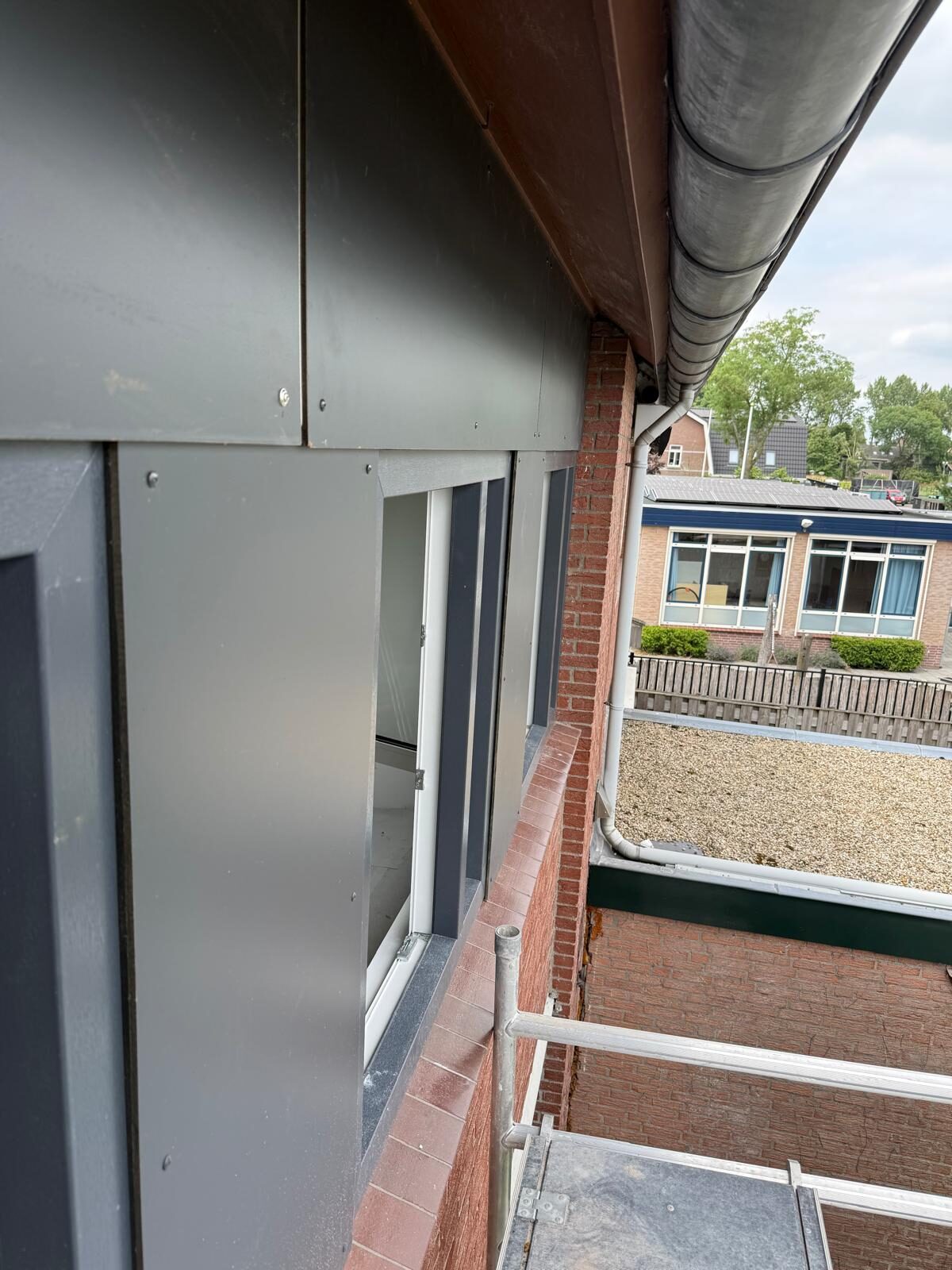
The facade work online at the moment is an upper floor I fitted with new cladding, in flat panels around the existing window frames and running up under the roof edge. Those photos were taken during the work, with the mobile tower still against the wall. It is panel material, so read it as an example of how a job like that runs and not as proof for a material you do not see lying there.
I work on my own, out of Nieuwegein, and I stand on the scaffold myself. So I can only work on one facade at a time and my planning is tight because of it. It also means you have one number and there is nobody to point at if something goes wrong. Besides Nieuwegein I work in the towns around it, so in Utrecht and the surrounding area you can ask me to come round as well.
What sets the price
The price of a facade seldom sits in the material and nearly always in the hours. A surface without breaks in it almost clads itself; it is the window frames, the dormer and the transition to the roof where the time goes. On top of that the height weighs heavily, because scaffolding is a fixed cost you only want to pay once. If other outside work is running in the same period, that is the moment to combine them.
What it comes down to
- How many square metres of wall, and whether it is one surface or several sides
- The height, because that decides whether a mobile tower will do or a scaffold or cherry picker has to come
- The number of breaks: window frames, dormers, vents, downpipes and corners cost the most hours
- The material you pick, and whether the system prescribes its own profiles and clips
- The state of the existing wall or substructure, and whether that needs repair first
- Whether insulation goes behind the cladding and the wall gets thicker because of it
What is included
- Measuring up at the wall itself, not off a photo
- The batten frame, the breather membrane and the vent mesh at the bottom
- Fitting the cladding, including cutting and fitting to size
- The finish around window frames, corners and the junction with the roof edge
- Clearing up and taking away the building waste and the old cladding
What comes on top
- Scaffold or cherry picker if the height of the wall calls for it
- Structural repair to a wall or substructure that turns out not to carry the load
- Insulation material, unless we put it in the job up front
- Painting existing window frames and replacing the rainwater downpipe
- Fees and costs of a permit application, if one is needed
Send a few photos of the situation and say briefly what you want. Then you hear from me what it will cost in your case, itemised and with no strings attached.
This in more detail
Parts of this service with a page of their own, so you find exactly what you are looking for.
Also in these towns
I work out of Nieuwegein and come to the whole region. These are the towns with a page of their own.
Background and cost questions, explained without the sales talk.
- Types of facade claddingSix types of facade cladding are common in the Netherlands: wood, composite, plastic, brick slips, fibre cement and zinc. All six do the same job, which is keeping the rain off your facade and giving your house a different face. The difference sits in maintenance, in how they age and in what sort of house they suit. Wood asks the most and gives the most back, composite and plastic ask little but what breaks you replace, brick slips and fibre cement stay the same for years, and zinc changes slowly and lasts the longest.
- Maintenance-free facade claddingNo. Maintenance-free does not exist, low-maintenance does. There is no facade you never have to look at again, but there is a big difference between a facade that asks for a bucket of water and a facade that asks for scaffolding, a sander and a fresh coat of paint. What each material really asks of you is manageable, and the choices that bring the maintenance down you make beforehand, not afterwards.
Frequently asked questions
What does facade cladding cost?
I do not put figures on this site, because a figure without your wall next to it says nothing. What sets the price I can name: the height of the wall, because the scaffolding hangs off that, the number of breaks in the wall, the state of the substrate, the material you pick and whether insulation goes behind it. A blank side wall is less work than the same area of wall with window frames, a dormer and a downpipe in it.
Which material needs the least maintenance?
Plastic and brick slips. Plastic you keep clean with water and a brush, brick slips ask for practically nothing once they are on beyond keeping an eye on the pointing. Composite sits just behind those two. Wood asks the most, unless you let it weather grey on purpose.
Can cladding go over an existing wall?
Usually it can, but not blind. First I check whether the substrate carries the batten frame and whether there is no damp or cracking behind it. Cladding over a problem makes the problem invisible, not solved, and years later you meet it again at a higher price.
Do I need a permit for facade cladding?
That depends on your council, on whether it is the front of the house and on whether your property sits in a protected townscape. I think through with you what you need to ask before we order material, but the application itself runs in the owner's name. If in doubt, ring the council before you pick a colour.
Can I have just the upper floor clad?
Yes, that works. The ground floor stays brickwork and the upper floor gets cladding, which makes the house look lower and wider. The junction between the two surfaces is then the point where the craft shows.
Do you work on the facade of a commercial building?
Yes. The work itself differs little from a house, the planning does. Taller walls need a scaffold or a cherry picker, the business usually has to keep running, and some buildings carry requirements on how the cladding material behaves in a fire. Those I get from the supplier before we choose.
What customers say about this work
“I am really happy with how Dido carried out the work. I had a leak and a mould problem at my kitchen sink. He replaced the tap and the basin and parts of the plumbing. The result turned out really nicely. Dido knows his trade very well and is very solution-minded. I will definitely hire him again for other jobs.”
Translated from Dutch
“I am really happy with how Dido carried out the work. I had a leak and a mould problem at my kitchen sink. He replaced the tap and the basin and parts of the plumbing. The result turned out really nicely. Dido knows his trade very well and is very solution-minded. I will definitely hire him again for other jobs.”
Translated from Dutch
“An honest businessman who is happy to think along with you. During the renovation he also helped with other small things he hadn't come for. Recommended”
Translated from Dutch
Tell me briefly what is going on
Three short steps. I look at it and call you back to talk it through.
1/3
Sent
Thanks, I have got it
I am on the tools myself, so it can take a few hours before I reply. If you are in a hurry, feel free to call.
Call me: 06 27 74 57 05Want this job done?
Tell me briefly what is going on. I talk the approach through with you and give you a price you can build on.
Need this too?
I do more than just this. Feel free to combine jobs in one visit.
- RenovationOne room, one floor or the whole house. One point of contact from start to finish.View this service
- Commercial & hospitalityRestaurants, bars and commercial spaces. Every day you are shut costs you money, so I plan the work around that.View this service
- Carpentry & fittingFurniture, dressing rooms, fitted wardrobes and assembly. Built to measure so it fits exactly where it has to.View this service
- Bathroom & sanitaryA complete new bathroom, or just the tap, shower or toilet. From strip-out to the last bead of sealant.View this service
- Floors & tilesFloors and tiling laid tight, from living room to hallway. Straight, level and finished neatly.View this service
- Garden & landscapingLayout, paving, trees and planting. With 7 years of agronomy (the science of soil and crops) I know the ground and the plants that grow in it.View this service
- Handyman & maintenanceThat list of small jobs you keep putting off. Get it ready and I work through it in one visit.View this service
- Extensions and annexesExtra room without moving house, built on site from the foundation to the skirting board.View this service
- RoofingRoof renovation, roof extensions and dormers out of Nieuwegein. Roofing as building work by one tradesman, not a roofing firm.View this service