Services
Bathroom renovation in Nieuwegein
A complete new bathroom, or just the tap, shower or toilet. From strip-out to the last bead of sealant.
A bathroom renovation is something I do myself from strip-out to handover. Stripping out, pipework and drainage, fall and waterproofing, tiling, sanitary ware and the last bead of sealant. One point of contact from start to finish, so you do not have to book a plumber, a tiler and a fitter separately.
What I do for you
A new bathroom is something I handle from start to finish. I strip out the old one, run the pipework and drainage, tile the walls and the floor and fit the toilet, the shower and the vanity unit. One point of contact, so you do not have to book a plumber, a tiler and a fitter separately.
You can come to me for smaller work too. A dripping tap, a new shower screen or a toilet that needs replacing, I sort that in a single visit.
You get a clear quote up front with what happens and what it costs. At the end you have a bathroom that is watertight and sealed neatly.
I work in Nieuwegein and Utrecht, and for a bigger job further out into the region.
How I go about it
- Complete bathroom from strip-out to handover
- Tiling walls and floors
- Fitting showers, baths and walk-in showers
- Replacing toilet, tap and vanity unit
- Running pipework and drainage
- Watertight sealant lines
A bathroom renovation is work whose most expensive part you never see again. You see the tiles, you see the vanity unit, you see the tap. What you do not see is the drain sitting on the right fall, the waterproofing in the shower corner, the pipework behind the wall and the substrate the tiling rests on. That is exactly where the difference sits between a bathroom that lasts and a bathroom that looked lovely on handover day.
Below is what such a renovation involves, in what order I work, when it can be done without ripping everything out, and where the price comes from. I do the work myself, so you hear it from the man who will be on his knees in that shower corner.
What happens under the tiles
Strip-out is the stage where a bathroom turns honest. As soon as the old tiling comes off, you finally see the state of the walls behind it. Plaster blocks that have drawn moisture, a timber wall that is softer than it should be, pipes running somewhere other than you would guess from where the taps sit. That is why I order the final tiles after the strip-out and not before. Do it the other way round and halfway through you have to choose between waiting and improvising.
Then comes the pipework. Supply and drainage go in where the sanitary ware is going to sit, not where it used to sit. Move a toilet or a shower and that is the job that costs the most work, because a drain needs fall and that fall has to come from somewhere. In a house with a concrete floor that often means the pipe disappears into a raised section of floor.
Then the fall and the waterproofing. The shower floor has to run down to the gully or the channel, and you build that into the substrate, not into the tile adhesive. On that substrate goes a waterproof layer, with sealing tape in the corners and around every pipe penetration. This is the part you never see again, that is on no photo at all, and that decides whether the ceiling of the room below is still dry in a few years. It belongs in a quote by name. If it is not there, ask about it.
Only after that do the tiles go on, then the sanitary ware, and right at the end the sealant. That order is not flexible. Every step needs the previous one dry and flat, and that waiting is exactly why a bathroom is not finished in a weekend.
Renovating a bathroom without breaking anything out
Not every bathroom has to come out. If the layout works, the sanitary ware sits in the right place and there is nothing wrong behind the tiles, you get a long way without a sledgehammer. That saves on rubble removal, it saves on disruption and it saves on cost.
What is possible then: tiling over the existing tiles, raking out the grout and refilling it, replacing every bead of sealant, renewing the shower screen or the glass, swapping the taps and the shower set, taking out the old vanity unit and putting in a new one with a mirror. Replacing a toilet or a basin can usually be done without opening up the wall too, as long as the connections stay where they are.
What honestly comes with that. Tiling over tiles only works if the bottom layer is rock solid. If a tile sounds hollow when you tap it, the new layer will eventually come off together with the old one. The floor also gets thicker, and you pay those millimetres back at the door, the threshold and the height of the shower tray. And the most important one: if water has ever got behind the tiles, a new layer solves none of it. You make it invisible, and invisible damp is more expensive than visible damp.
So I tell you up front, after looking and not after starting, whether this is a bathroom you can do up or a bathroom where doing it up is a waste of your money. If I am in any doubt I take one tile off to see what is behind it. That is a small hole against a big assumption.
What makes a bathroom renovation more or less expensive
I do not put figures on this site, because an amount without your bathroom next to it says nothing. What it depends on I can explain, so you can lay two quotes side by side and understand why they differ.
It gets more expensive mainly from moving things. If the toilet stays where it stands and the shower comes back in its old spot, the renovation is essentially strip-out, build-up and finishing. Move the sanitary ware and the floor or the wall opens up for new drainage, and that is the heaviest item there is.
Other things that weigh in: the number of square metres of wall that has to be tiled, and that is almost always more than people estimate. The size of the tile, because a large tile needs a flatter substrate and more cutting. The pattern, because mosaic and herringbone cost far more hours per square metre than a straight bond. Whether a walk-in shower with no threshold is going in. And the state of what sits underneath, which you only know for sure after the strip-out.
It gets cheaper from choices nobody sees and you do notice yourself. Leaving the sanitary ware where it is. A common tile size in a straight bond. Wall tiles up to a sensible height instead of everywhere up to the ceiling. And having it all done in one go instead of in stages, because building up and clearing away again every time costs time you pay for twice.
One thing does not push the price down but does protect it: choose your materials before the work starts. A tile that turns out to be unavailable halfway through brings the whole planning to a stop.
Walk-in shower, bath, or both
The biggest choice in a bathroom is not the colour, but whether a bath stays in. A bath costs space you lose from the shower, and in most bathrooms there is no room for both. So I always ask: how often has that bath been used in the past month? An awkward question with an often very clear answer.
Go for a walk-in shower with no threshold and the tiled floor runs on into the shower, with the water leaving through a linear drain or a gully. That asks more of the fall and of the waterproofing, but it makes a small bathroom look bigger and it is the version you can keep using later without alterations once stairs and stepping over things get harder. What that looks like is on the project page of a walk-in shower with no tray and no threshold.
Grout, sealant and ventilation
Three things a bathroom usually gives up on first, and none of them is a big job.
Grout is not a seal but a filler. The waterproof work sits underneath it. Grout that discolours or goes powdery you rake out and refill, and that is small work instead of a refurbishment.
The beads of sealant in the corners and along the shower tray are deliberately flexible, because that is where the structure moves. That makes sealant a wear part. If it goes black or lets go, that is not a cleaning problem but a replacement job, and the sooner you do it, the less sits behind it.
Ventilation is the part most often skipped in a renovation and most often the reason there is mould on fresh grout. A bathroom has to be able to get rid of its moisture, through a window or through extraction that really pulls. If there is an old, clogged extractor in the ceiling, the moment to deal with it is exactly the moment that ceiling is open anyway.
A builder for the bathroom, or separate trades
Renovating a bathroom is not one trade. There is strip-out in it, pipework, tiling, some carpentry and fitting out. Arrange that separately and you are the one keeping the order, and the one making the calls when the tiler is standing at a locked door because the pipework is not finished.
With me it hangs on one number. I do the strip-out, the pipework, the waterproofing, the tiling and the fitting out myself, so I plan the order against my own diary instead of against that of four firms. That has a limit too and I would rather name it up front: I work on my own, so I can only be on one bathroom at a time and my planning is tight because of it. What you get back is that there is nobody to point at when something goes wrong.
If the bathroom runs along with a bigger renovation of a floor or the ground floor, that is the moment to combine it. The same goes for the tiling and flooring in the rest of the house, because tiles from the same delivery match each other better than tiles you order again a year later. And if it stays with a dripping tap or a shower screen that needs replacing, that simply falls under one-off jobs and maintenance.
The bathrooms that are online
With this kind of work photos say more than a description. There are a few on the site, and they deliberately show different kinds of job.
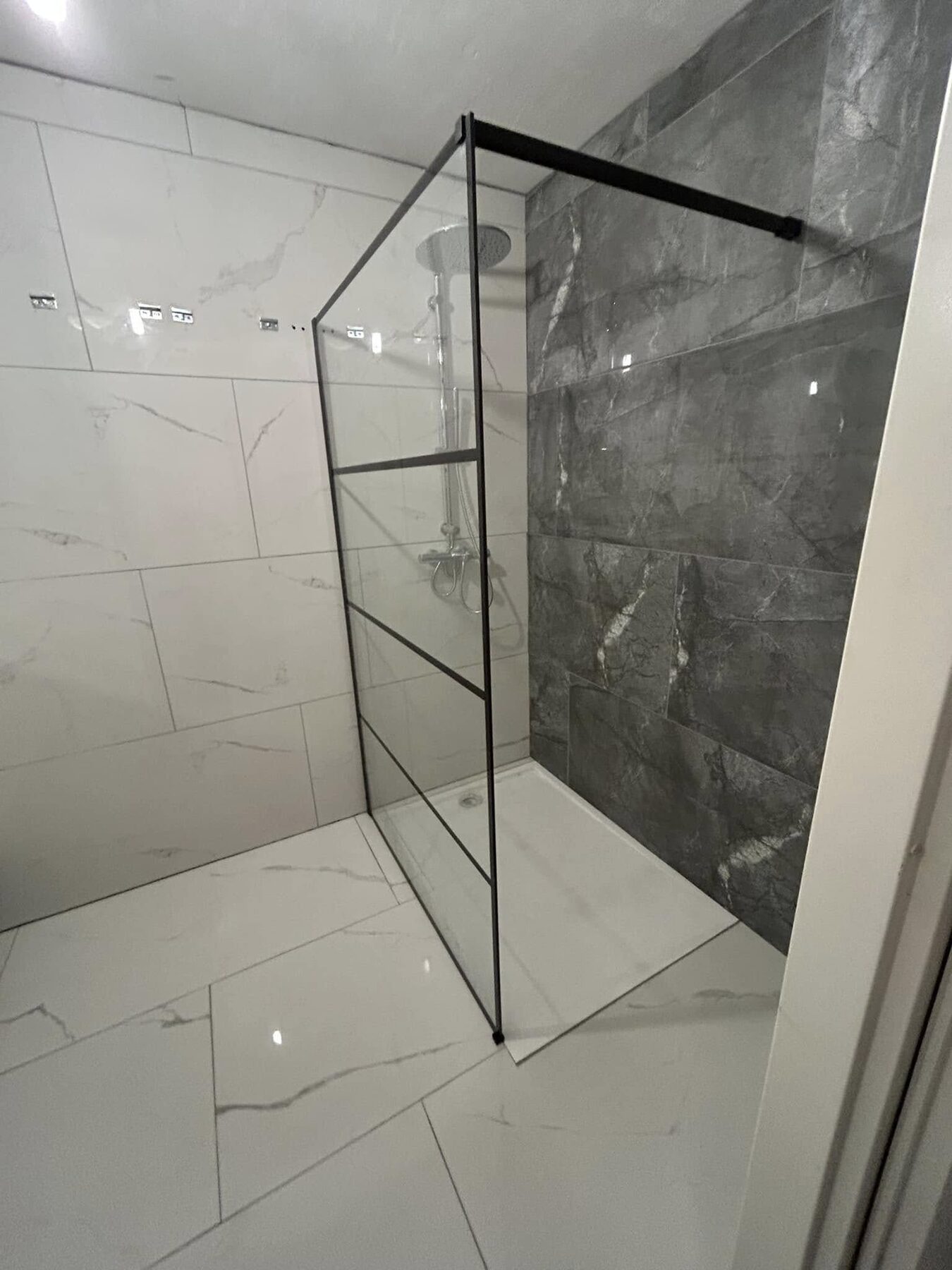
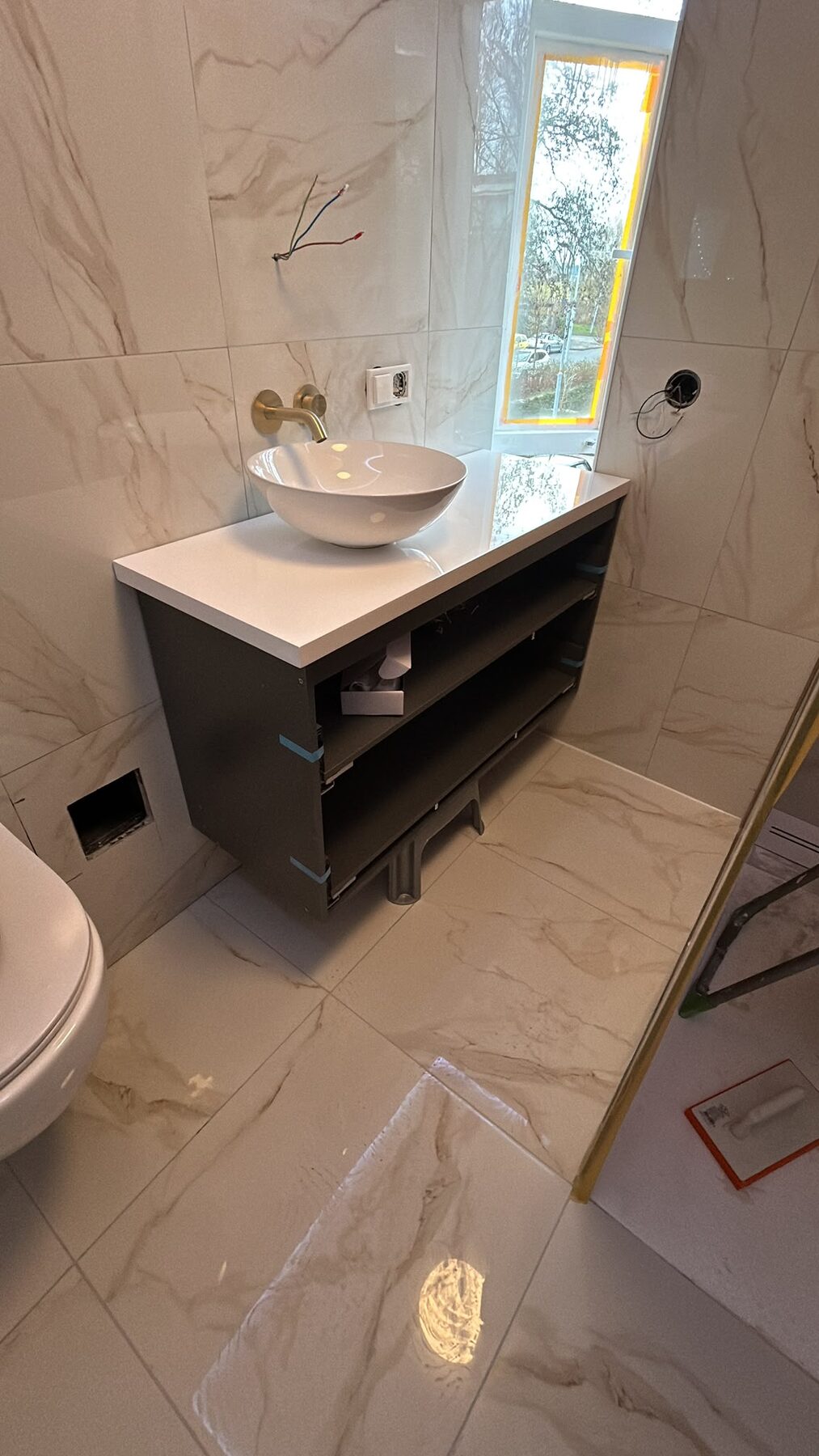
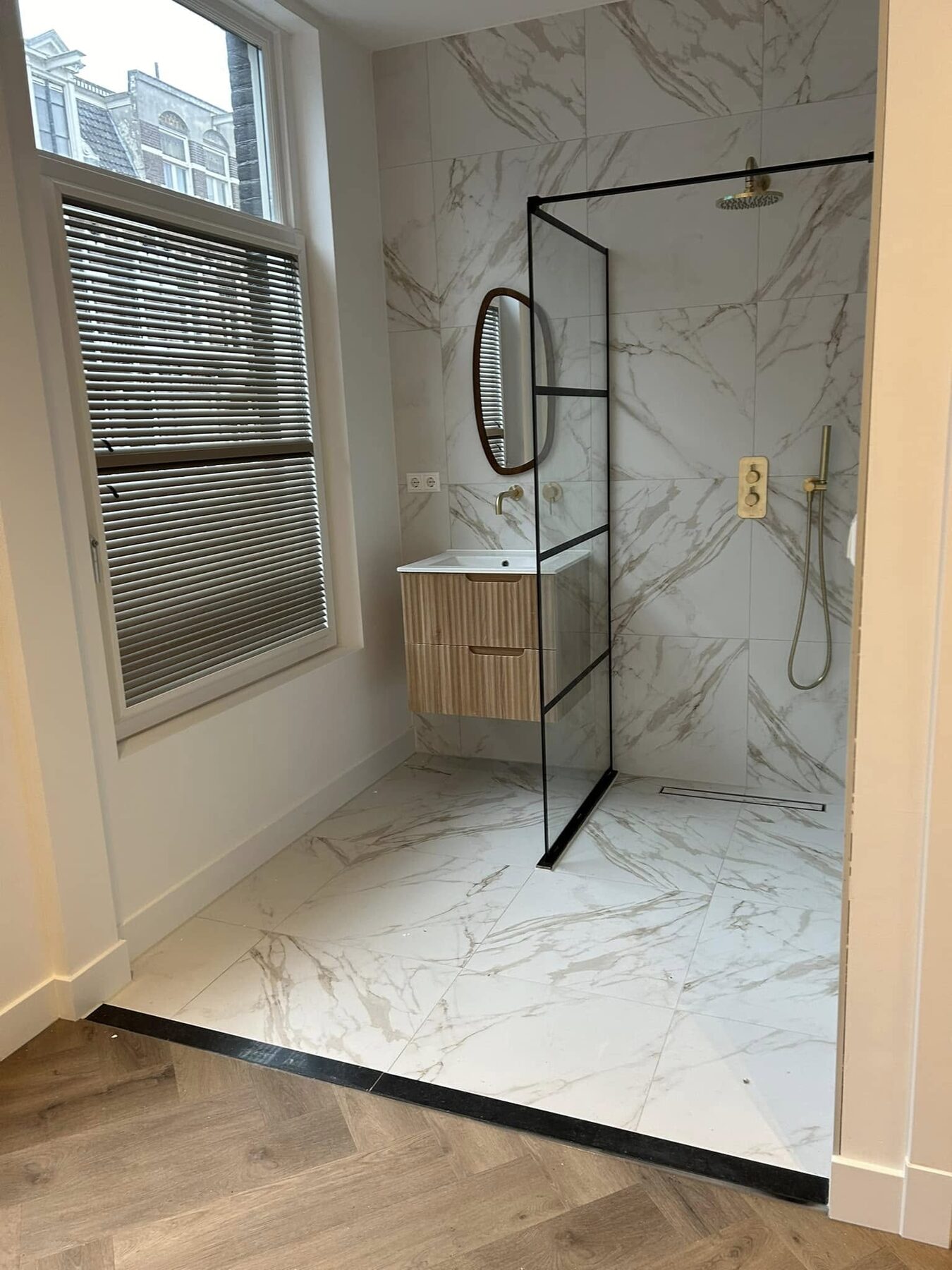
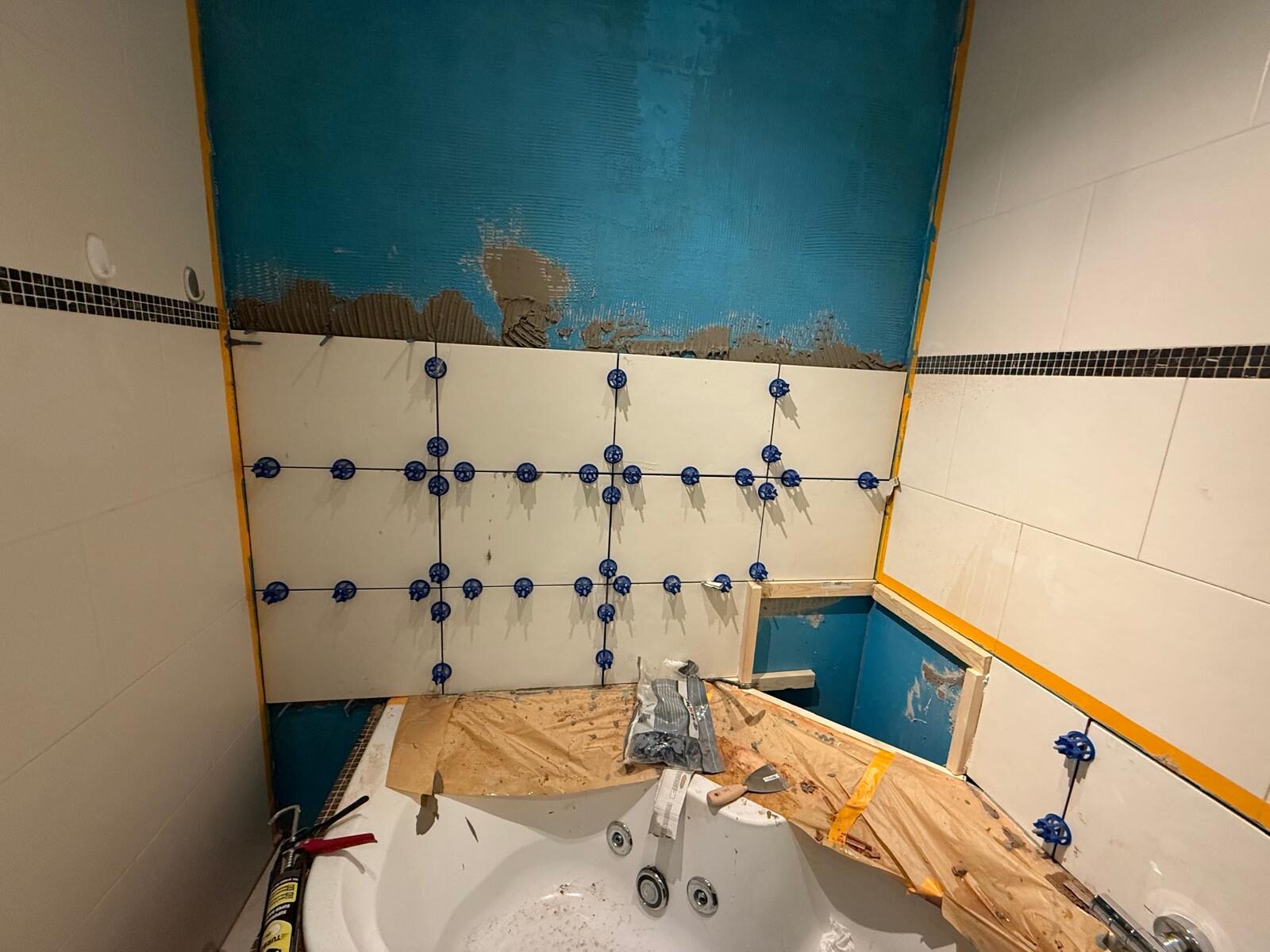
A bathroom in white marble look with an anthracite wall behind the shower, with black framed glass and a floating vanity unit. A bathroom in marble look with gold taps, where wall and floor run on in the same large format. And a job from the other end of the spectrum: a wall around an existing bath that has been retiled, where the bath simply stayed where it was and only the wall was stripped back. That last one is exactly the work you do not have to demolish your whole bathroom for.
Where I renovate bathrooms
I work out of Nieuwegein and come to the towns around it. For bathrooms and renovations in Utrecht I do not have far to go either, so coming by once more to take measurements or to look at a tile choice in real life is no problem.
If you want to know what your bathroom is going to cost, send me a few photos. One of the whole room, one of the shower corner and one of the ceiling. I get a lot out of that. Then I come and measure, because dimensions you read off a photo are not right, and in a bathroom every centimetre counts.
What sets the price
The price of a bathroom only sits partly in what you pick out. The biggest part sits in hours, and those hours sit in two things: moving and cutting. If everything stays where it is and a standard size tile goes on in a straight bond, it is a straightforward job. If the toilet moves, a walk-in shower with no threshold goes in and large or irregular tiles go on, it all adds up. What also makes a quote honest is the item you cannot check later: the fall and the waterproofing under the tiling. If that line is missing, you are comparing two quotes that do not promise the same thing.
What it comes down to
- Whether the sanitary ware stays put or gets moved, because new drainage is the heaviest item in a bathroom
- The number of square metres of wall and floor to be tiled, and how high the wall tiles run
- The tile size and the laying pattern, because mosaic and herringbone cost far more hours than a straight bond
- Whether a walk-in shower with no threshold is going in, because that needs a lowered floor or a build-up with extra fall
- The state of the walls and the floor under the old tiling, and that you only know for sure after the strip-out
- Whether the bathroom is done in one go or in stages, because building up and clearing away again is something you pay for twice
- Access: a bathroom in the loft behind a narrow staircase costs more hours of carrying than a bathroom downstairs
What is included
- Measuring up in the bathroom itself, not from a photo
- Stripping out the old tiling and the old sanitary ware
- Running supply and drainage pipework to where the sanitary ware is going to sit
- The fall and the waterproof layer, with sealing tape in the corners and around the pipe penetrations
- Laying wall and floor tiles, grouting and the boxing in around pipework
- Fitting and connecting the toilet, the shower, the vanity unit and the taps
- Finishing the beads of sealant and taking away the building waste and the old sanitary ware
What comes on top
- The sanitary ware and the tiles themselves, unless we agree that I order them for you
- Work on the gas line or the consumer unit, which I leave to a certified installer
- Extending the electrics to a new circuit, or a new ventilation duct through the roof or the facade
- Repairs to a floor or a wall that turns out to be structurally unsound after the strip-out
- Painting, ceiling finishes and a new internal door, unless we include that up front
- Survey and removal if there turns out to be asbestos in the old floor covering or tile adhesive
Send a few photos of the situation and say briefly what you want. Then you hear from me what it will cost in your case, itemised and with no strings attached.
Also in these towns
I work out of Nieuwegein and come to the whole region. These are the towns with a page of their own.
Background and cost questions, explained without the sales talk.
Frequently asked questions
What does a bathroom renovation in Nieuwegein cost?
That depends on the size, the sanitary ware and the tiling. A toilet or a small bathroom is done sooner, a complete renovation is a bigger job. You get a clear quote up front with what happens and what it costs.
How long does a bathroom renovation take?
That depends on what comes out, whether the sanitary ware gets moved and how much drying time the work needs. Strip-out, pipework, waterproofing, tiling and fitting out come in a fixed order, and every step needs the previous one dry and flat. You get the planning before I start, and I tell you if anything runs over.
Do you do the whole bathroom or only the tiling?
Both. From just tiling or a new tap to the complete bathroom: strip-out, pipework, tiles and sanitary ware from one hand, so you do not have to book a separate tiler and fitter.
Can you run the sanitary ware and the pipework as well?
Yes. I run the drainage and the pipework for the bathroom and fit the toilet, the shower and the taps, so the whole bathroom sits with one point of contact.
Can a bathroom be renovated without breaking anything out?
Often it can, if the layout works and the sanitary ware stays where it is. Then I tile over the existing tiles, rake out the grout, replace every bead of sealant and swap the taps, the shower screen and the vanity unit. The condition is that the old tiles are rock solid and that there is no damp behind them. If a tile sounds hollow when you tap it, the new layer will eventually come off together with the old one, and then doing it up is a waste of your money.
Are you a builder for the bathroom, or do I need a plumber as well?
I am enough on my own. Strip-out, supply and drainage pipework, waterproofing, tiling and fitting the sanitary ware I do myself, so you do not have to book a tiler and a fitter separately and have them wait on each other. Work on the gas line or the consumer unit I leave to an installer who is certified for it, and I say so up front.
Can I keep living at home during a bathroom renovation?
Usually you can, but count on not being able to use the bathroom for part of the time. If there is a second toilet in the house, it is manageable. If there is not, I put the toilet back as early as I can or we agree that you shower somewhere else for that period. I say up front when it really will not work, so you can arrange something.
Why do quotes for the same bathroom differ so much?
Usually because of what is not in them. With every quote, ask about three things: the fall and the waterproofing under the tiling, who pays for taking away the rubble and the old sanitary ware, and whether the sanitary ware gets moved or stays where it is. That last one is the heaviest item there is. Two quotes with the same end result can be completely different on that point.
Featured work
The proof is in and around the house.
What customers say about this work
“I am really happy with how Dido carried out the work. I had a leak and a mould problem at my kitchen sink. He replaced the tap and the basin and parts of the plumbing. The result turned out really nicely. Dido knows his trade very well and is very solution-minded. I will definitely hire him again for other jobs.”
Translated from Dutch
“I am really happy with how Dido carried out the work. I had a leak and a mould problem at my kitchen sink. He replaced the tap and the basin and parts of the plumbing. The result turned out really nicely. Dido knows his trade very well and is very solution-minded. I will definitely hire him again for other jobs.”
Translated from Dutch
“An honest businessman who is happy to think along with you. During the renovation he also helped with other small things he hadn't come for. Recommended”
Translated from Dutch
Tell me briefly what is going on
Three short steps. I look at it and call you back to talk it through.
1/3
Sent
Thanks, I have got it
I am on the tools myself, so it can take a few hours before I reply. If you are in a hurry, feel free to call.
Call me: 06 27 74 57 05Want this job done?
Tell me briefly what is going on. I talk the approach through with you and give you a price you can build on.
Need this too?
I do more than just this. Feel free to combine jobs in one visit.
- RenovationOne room, one floor or the whole house. One point of contact from start to finish.View this service
- Commercial & hospitalityRestaurants, bars and commercial spaces. Every day you are shut costs you money, so I plan the work around that.View this service
- Carpentry & fittingFurniture, dressing rooms, fitted wardrobes and assembly. Built to measure so it fits exactly where it has to.View this service
- Floors & tilesFloors and tiling laid tight, from living room to hallway. Straight, level and finished neatly.View this service
- Garden & landscapingLayout, paving, trees and planting. With 7 years of agronomy (the science of soil and crops) I know the ground and the plants that grow in it.View this service
- Handyman & maintenanceThat list of small jobs you keep putting off. Get it ready and I work through it in one visit.View this service
- Facade claddingNew exterior facade cladding in wood, composite, plastic or brick slips, on a batten frame that lets the wall breathe.View this service
- Extensions and annexesExtra room without moving house, built on site from the foundation to the skirting board.View this service
- RoofingRoof renovation, roof extensions and dormers out of Nieuwegein. Roofing as building work by one tradesman, not a roofing firm.View this service