My specialty
Landscape gardener in Nieuwegein for garden design and paving
Layout, paving, trees and planting. With 7 years of agronomy (the science of soil and crops) I know the ground and the plants that grow in it.
I lay out gardens, paving and planting in Nieuwegein, with seven years of agronomy behind me. I know the ground, so the planting I choose holds up.
What I do for you
This is where my background pays off. Seven years of agronomy means I look at your soil before I pick a plant. Heavy clay asks for something else than sand, and a north-facing wall asks for something else than full sun.
An overgrown garden I turn back into a place to sit. I lay paving and paths, put in borders and planting and choose trees and shrubs that can cope in your spot.
Maintenance is part of it too. Pruning, filling in a border again or taking out a tree that has to go. I prune so the plant does even better next season.
I work in Nieuwegein and Utrecht, and for a bigger job further out into the region.
How I go about it
- Complete garden design and makeover
- Paving, patios and paths
- Borders and planting matched to the soil
- Planting or removing trees and shrubs
- Groundwork and levelling
- Pruning and maintenance
Garden work is the only work I do where the ground underneath is an unknown. Indoors I know what I am dealing with once the strip-out is done. In a garden I only know that when the first spade goes in, and that is where most of the difference between two quotes comes from. One has counted the groundwork and the waste removal, the other assumes it will not be too bad.
Below is what a fence, paving and trees really come down to. And what seven years of agronomy adds to that in practice, because that is the reason I dig a hole before I pick a plant.
Putting up a fence: it is all in the posts
Almost everyone picks the panels first. Colour, wood or composite, closed or with a gap between the boards. Understandable, because that is what you see. But a fence that leans after a few years leans because of the posts and because of the ground around them. The panels are rarely the problem.
What happens below ground
A post has to sit deep enough to take the wind load of the panel next to it. A fence is a sail: the more closed and the higher it is, the more force lands on every post in a good westerly storm. In loose or wet ground that post has to go deeper, or it needs concrete around it.
The first thing I check in the garden is what is sitting in the boundary line. Old footings from a previous fence, rubble, a cable or the edge of a patio. That decides whether I can get through with the auger or whether every hole becomes hand work, and that makes more difference to the hours than the choice between two kinds of board.
The boundary itself is a conversation you would rather have beforehand than afterwards. If the fence sits exactly on the line it is a shared boundary and you need your neighbours in on it. Put it just inside your own ground and you decide on your own, but you are left with a strip you will never keep clear again. There is also a height above which you need a permit, and that limit is different for a front garden than for a back garden. Check that with the council before you order material.
Wood, concrete posts or composite
Wood is the cheapest to buy and the most expensive in attention. Softwood lasts a number of seasons as long as it is not standing in water, hardwood goes considerably longer. The weak spot is always in the same place, where the wood meets the ground. That is why I prefer not to set wooden posts in the ground but on concrete pads or in steel post holders, so the end grain stays dry.
Concrete posts with wooden panels are the compromise you see most in the Netherlands. Not everyone finds them good looking, but structurally it is settled: the post does not rot, and a worn panel can be swapped out on its own later.
I put up composite fences as well. Composite is wood fibre mixed with plastic, it needs no paint and it does not grey out. Two things I will say honestly about it. It is a good deal heavier than wood, so the posts and the footings have to be sized for that. And it expands in the sun: a composite fence pushed tight together in spring is jammed and bowing by summer. Most systems are also tied to one brand, so the panels, the posts and the capping rails all come from the same range. Buying more in a few years is then not a given.
Fence supplied and fitted, or fitting only
Both work. If you want a fence supplied and fitted, I order the material with it and you get one price for the lot: posts, panels, groundwork, fitting and taking away whatever was there. If the material is already lying there or you have ordered it yourself, I only fit it and I charge the hours. That second option is not automatically as cheap as you think, because material that has sat outside through a winter is often warped, and that doubles the trimming and cutting.
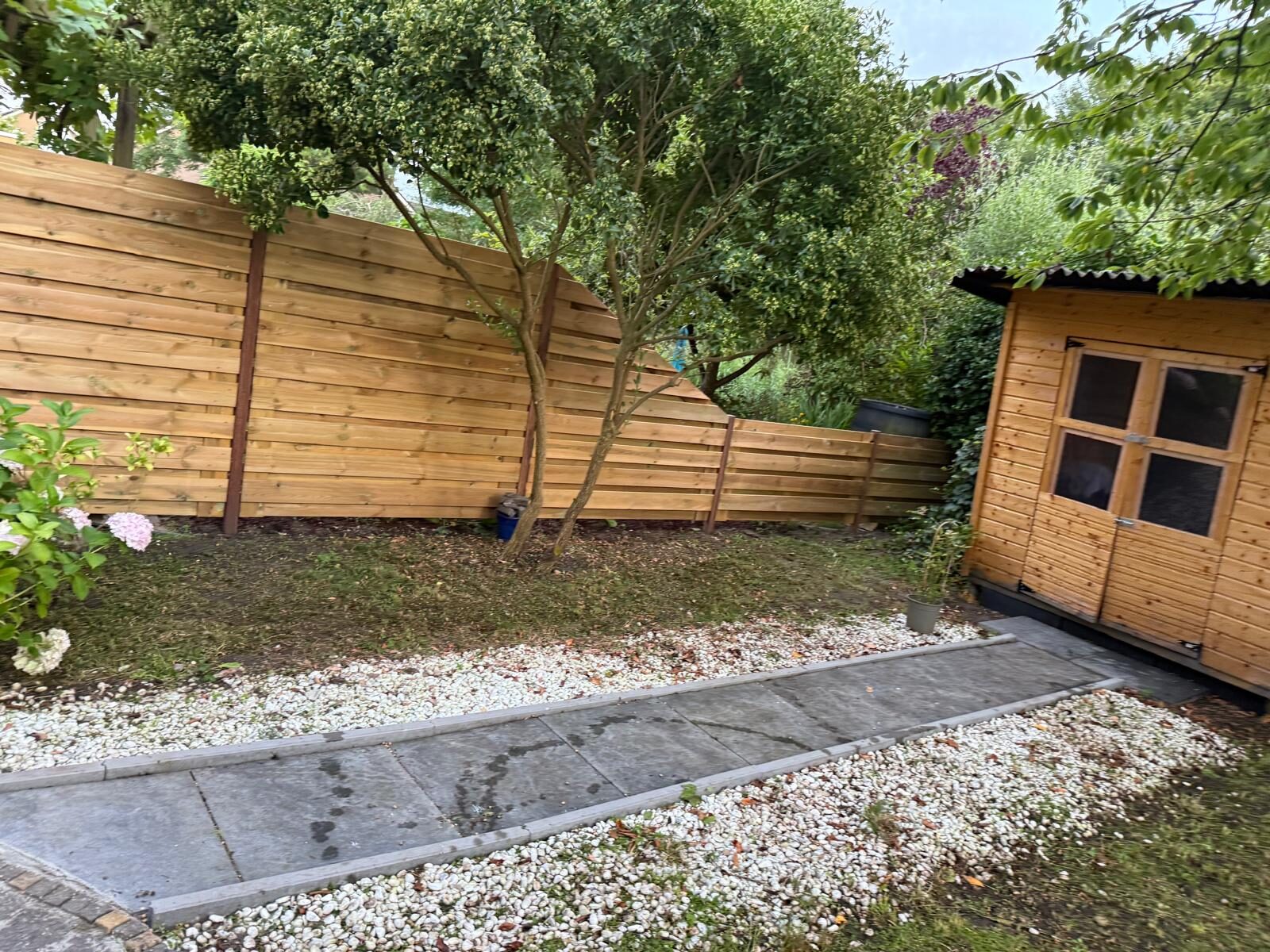
What a garden like that looks like when it is finished, with a new fence, a shed in the corner and a tiled path to the back, you can see at the back garden with a fence, a shed and a path. If a store, a gate or a canopy comes with it, that falls under carpentry and fitting, but in practice it is the same day and the same man.
Paving, patios and paths
Paving is the item people most often compare by the square metre, and that is exactly where it goes wrong. The stones are the smallest part of the work. The work sits underneath them.
Under a patio or a path belongs an excavated bed, a compacted base and a layer of sharp sand that gets vibrated in. Cut back on that and it does not sink straight away, but it sinks predictably: first at the gully, then along the wall of the house, and after a wet winter everywhere the water stands. So I always lay a fall away from the house, even though a patio that is dead level looks calmer to the eye.
What really sets the price per square metre is not the stone but the shape of your garden. A rectangular patio of plain slabs is simple and quick. As soon as curved edges, a gully, a tree pit or a path in a bond pattern come into it, the cutting takes over, and cutting is hours. Access counts just as heavily: can the sand go through a gate in a wheelbarrow, or does everything have to come through the house to the back.
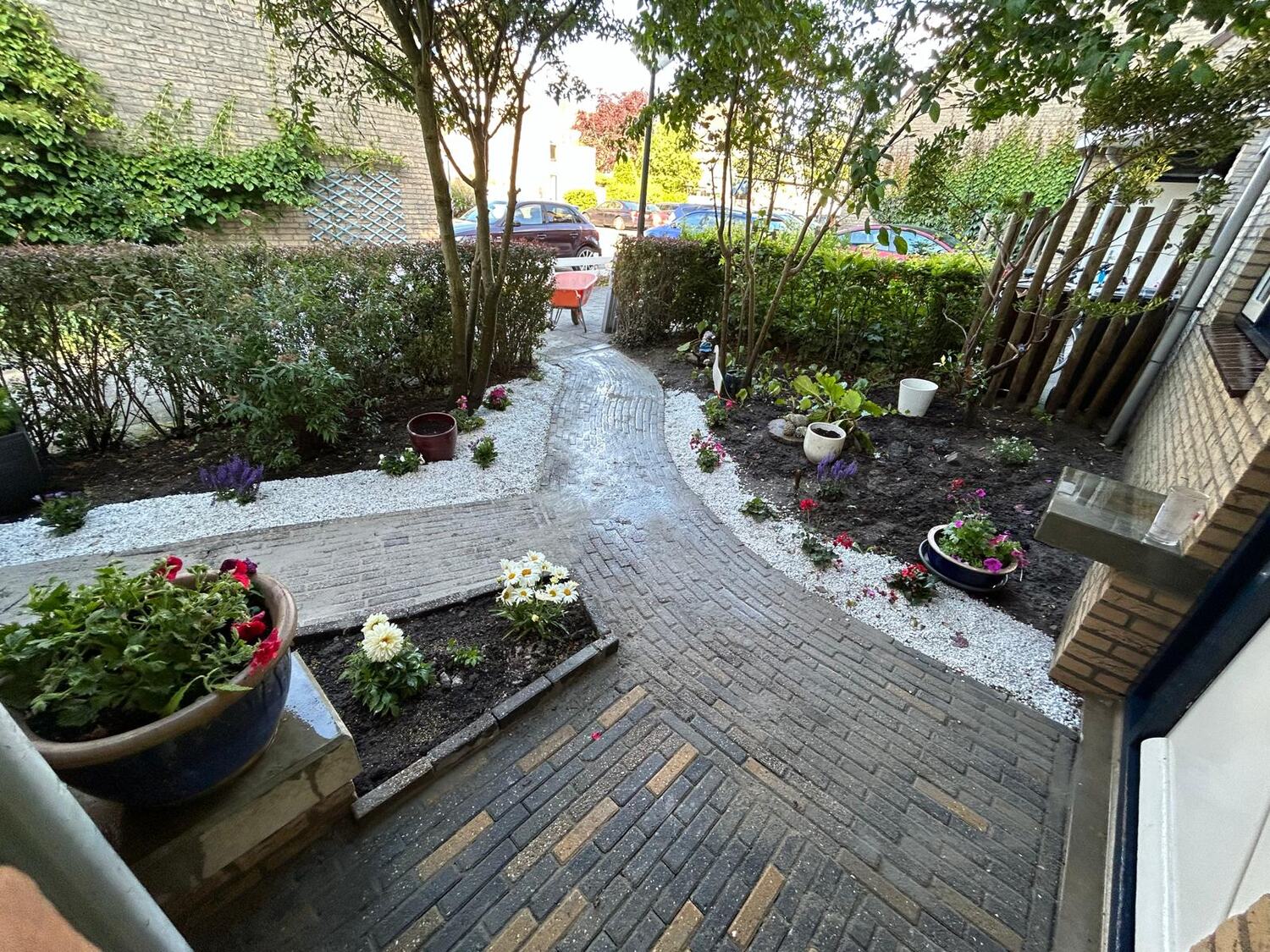
A garden where all of that comes together, with brick paths, a patio in a curved bond and new borders alongside, is at the paving with paths and borders around the house.
Trees: pruning, removing and felling
Trees are a big part of my garden work, and it is also the work where most goes wrong when somebody tries it themselves. A tree does not fall where you push it, it falls where its centre of gravity is.
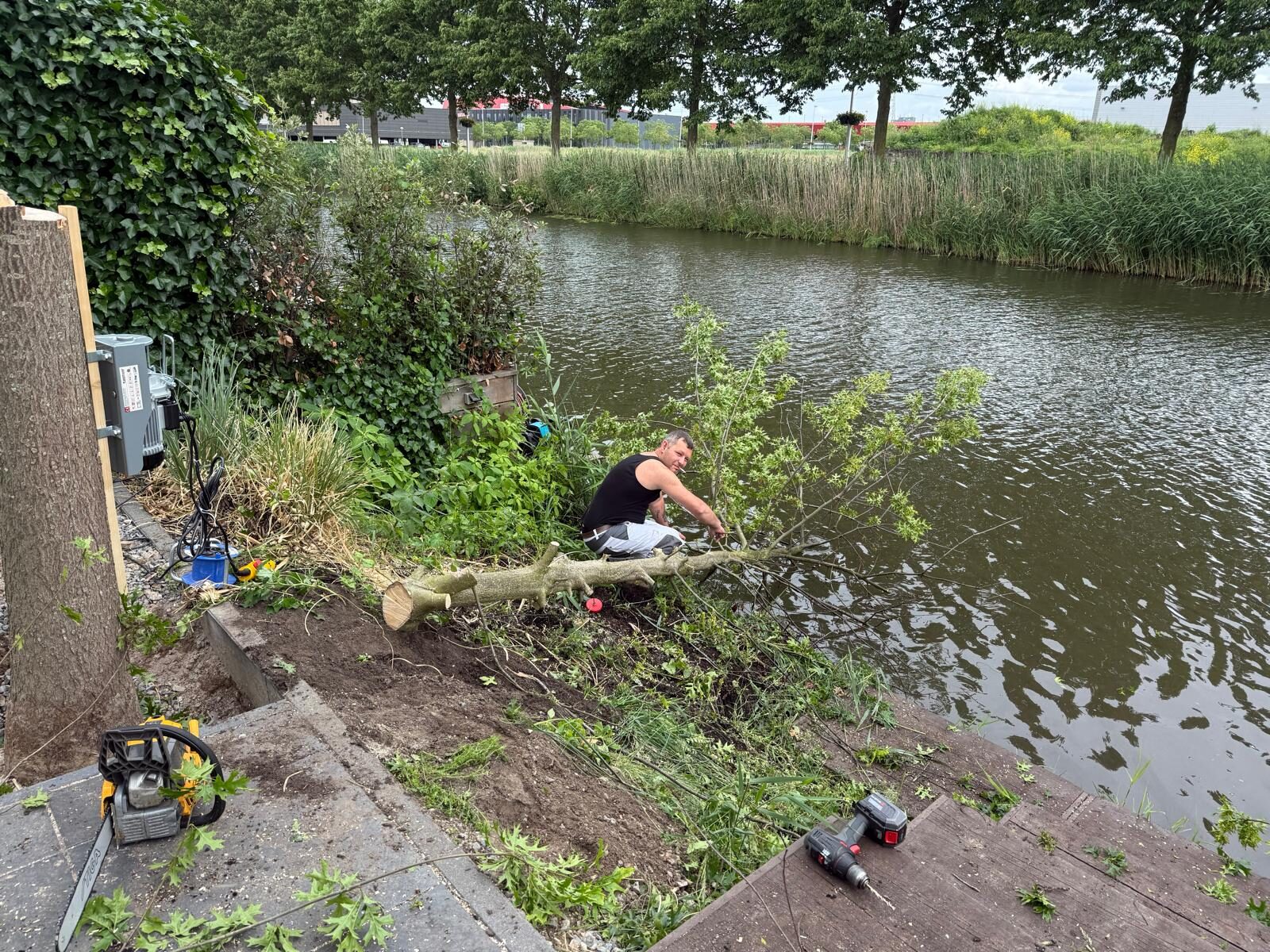
If there is room around it, a tree can come down in one go. In an average back garden that room is not there, so it comes down in sections: the branches first, then the trunk in pieces from the top down, with a rope or a winch to steer it. That is slower and it costs more hours, but the fence and the neighbours’ roof stay in one piece. What that looks like in practice you can see at the tree taken out at the waterside and at a conifer out of a tight back garden.
Always ask about the stump as well. Felling and removing are not the same thing: with felling the stump stays in the ground, with removing it comes out too. If you want to pave or replant that spot, the stump has to go, and that is a separate job with a stump grinder or with the digger.
If you want a tree felled in Nieuwegein or in one of the neighbouring councils, the first question is not what it costs but whether it is allowed. Councils each have their own rules on which trees need a permit, and some trees are separately on a protected list. I will tell you what to check, but the application goes in the owner’s name. Nesting season is the second question: if there is a nest in the crown, the work waits, even if that is inconvenient.
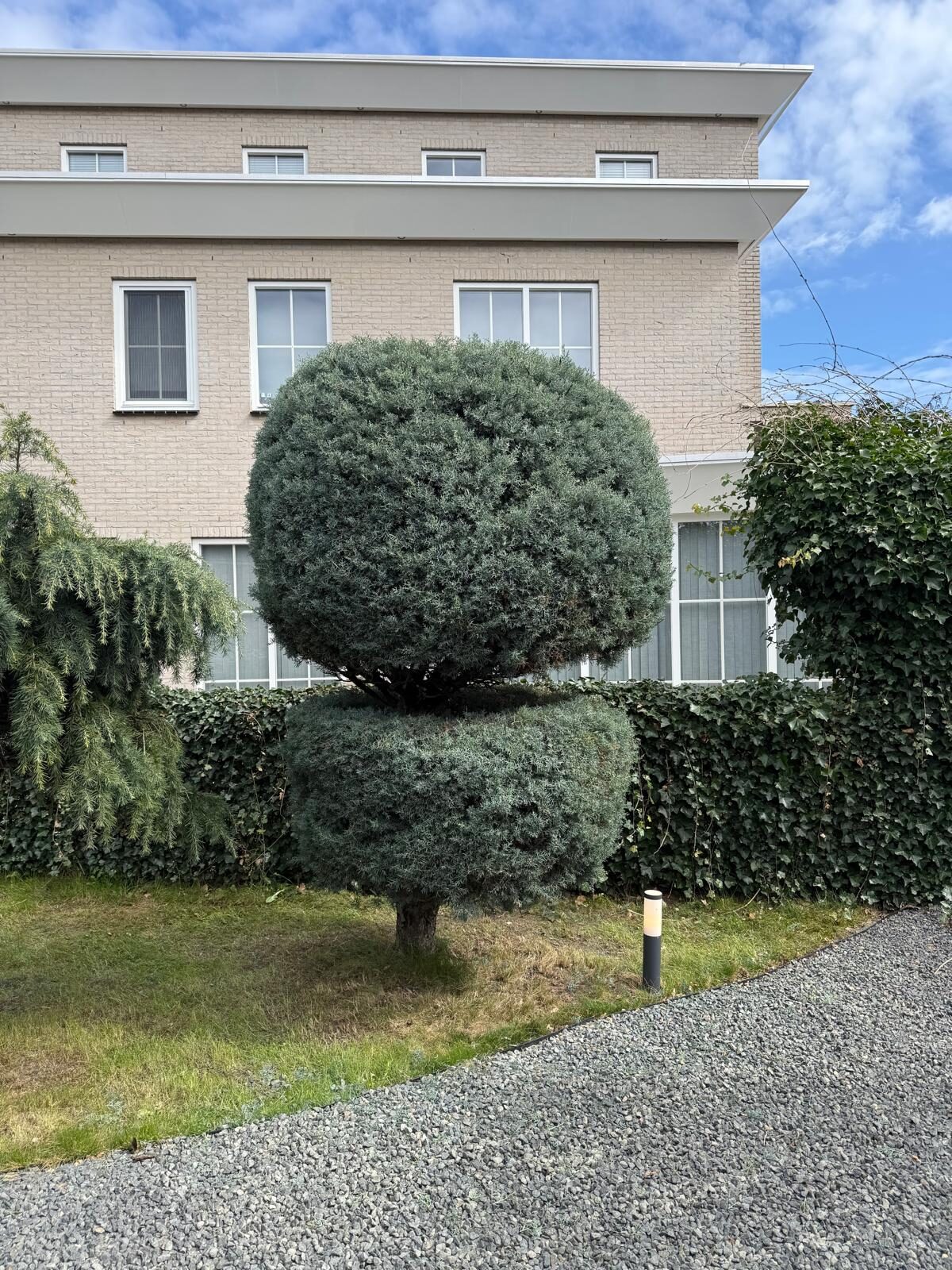
Pruning is a different trade from removing. With topiary and with older conifers there are species you cannot cut back into the old wood, because nothing comes back out of it. Push that one step too far once and you look at a bare flank for years. What I mean by that work you can see at topiary and tree care in a front garden.
The soil, and why a border does well one year and not the next
This is where my background comes in. Seven years of agronomy mostly means I do not judge a garden by what is standing above ground.
I dig a hole. What comes out tells you the most. Clay sticks to the spade and holds water, sand runs through your fingers and dries out in a warm summer, peat sinks and smells different. In a new-build garden I often find imported sand with building rubble as well, with the original soil underneath it driven flat by machines. A border that looks lovely there in the first season and then falls away is not falling away because of the plants, but because the roots hit that compacted layer and the water sits on top of it.
That is also the answer to why the same planting bed does fine next door. Sun, shade, water and soil can differ within a few paces. So I would rather pick a species that suits your corner than one out of a garden book, and where it really will not work I improve the soil first or put in drainage.
What a landscape gardener costs per hour, per day or per job
I do not put figures on this site, because a rate without your garden next to it tells you nothing. What it depends on I can explain.
There are three ways to settle garden work. Per hour is fairest on small and unpredictable work: pruning, doing up a border, a list of odds and ends. Per day works better as soon as I need machines or a skip, because I hire those by the day and not by the hour, and then half a day is rarely half the price. And on installation work, so paving or a fence, I would rather work for a fixed price: one price for the whole job, so the risk of a nasty surprise in the ground sits with me and not with you.
What comes back in all three cases: how much soil has to be moved and taken away, and how much trimming and cutting the shape of your garden creates. Waste removal is the item that gets forgotten most often and it is rarely small on garden work. A quote that is missing that item is not a cheap quote but an incomplete one.
How it goes
Send me a few photos of the garden, preferably one from an upstairs window as well, because from there I see the shape and the levels better than from the ground. I usually reply the same day, come and look, measure up and dig that hole. Only then do you know where you stand.
I work on my own, out of Nieuwegein. That means I am in one garden at a time and that my diary is tight in spring. It also means the same man lays your paving and picks your planting. Outside Nieuwegein I drive into the region every day, among other things for garden and building work in Utrecht. If there is a list indoors as well, I pick that up under odd jobs and maintenance.
What sets the price
On garden work the price is almost never in what you end up seeing. The stones, the panels and the plants are the smallest part, the hours go on groundwork, waste removal and trimming and cutting. That is why I ask whether I can dig a hole before I name a price: a compacted layer or old footings in the boundary line change the budget more than the choice between two kinds of wood. A rectangular area in a garden with good access is predictable work. A narrow back garden where everything has to go through the hallway in a wheelbarrow is not, and I would rather say that up front than have it turn up afterwards as extra work on your bill.
What it comes down to
- The length of the fence or the area of the paving, but even more the shape of it, because curved edges and obstacles mean cutting
- What is sitting in the ground: old footings, rubble, cables or a compacted layer under the topsoil
- How reachable the garden is, so whether material can go through a gate in a wheelbarrow or has to come through the house to the back
- Whether a machine can be used or the groundwork becomes hand work
- How much soil, old paving and green waste has to be taken away
- The choice of material: wood, concrete posts or composite, and whether the system prescribes brand-tied posts and profiles
- Whether a tree or a stump has to come out first before the rest can start
What is included
- Measuring up in the garden itself, including a trial hole to see what is under the topsoil
- Setting out the lines, the groundwork and compacting the base
- Fitting or laying, including the trimming and cutting around obstacles
- Finishing the edges and backfilling along the paving or the fence
- Raking over, clearing up and taking away the green waste and the building waste
What comes on top
- The material itself, unless we agree beforehand that I supply it
- Skip hire and a council permit for placing it if the skip has to stand on the street
- Fees and costs for a felling permit or for a permit for a high boundary fence
- Moving or repairing cables, pipework and drains that turn out to be in the way
- Irrigation, garden lighting and electrics in the garden
- Maintenance after the work is done, such as the first pruning season or topping up the borders
Send a few photos of the situation and say briefly what you want. Then you hear from me what it will cost in your case, itemised and with no strings attached.
Also in these towns
I work out of Nieuwegein and come to the whole region. These are the towns with a page of their own.
Background and cost questions, explained without the sales talk.
- What a landscape gardener costs per hourAn hourly rate tells you little about garden work, because it does not decide how many hours are needed and it says nothing about what else is in the price. What really makes the figure is taking away the soil and the green waste, the materials, the machine hire and the number of people on the job. So ask about those instead of about a rate.
- What putting up a fence costsA fence looks like a row of boards between two posts, but the figure at the bottom of the quote is set by what you do not see: the type of panel, the posts, what goes into the ground, the ground itself, the number of corners and end points, taking away and disposing of what stands there now, and whether a gate has to go in. Below is that build-up item by item, plus what you need to settle with your neighbours before you have anyone round to measure up.
Frequently asked questions
What makes DZRMS different from an ordinary landscape gardener?
I worked seven years in agronomy. I look at your soil, the sun and the shade first, and choose the planting to match. I also do the work indoors, so your garden and your house are with the same man.
What does it cost to have a garden laid out?
That depends on the size, the paving and the planting. From doing up a border to a complete makeover, you get a quote made for your garden beforehand, so you know where you stand.
Can you lay the garden out in the same style as the house?
Yes. Because I do the work indoors as well, the garden ties in nicely with your house in material and style, from the paving to the planting.
Do you also do garden maintenance, pruning and tree removal?
Yes. Besides laying out gardens I do maintenance: pruning, filling in borders again and planting or removing trees, with an eye for what the garden needs in the long run.
What does it cost to have a fence put up?
I do not put figures on this site, because the panels are rarely the biggest item. What sets the cost of putting up a fence is the length, the height, the number of posts and above all what is sitting in the ground. Old footings, rubble or a cable in the boundary line turns every hole into hand work, and that weighs heavier than the choice between wood and composite. I come and look, and then I put one price on paper for the whole job.
Do you put up composite fences too?
Yes. Putting up a composite fence does ask something different of the structure than wood. The material is a good deal heavier, so the posts and the footings have to be sized for it, and it expands in the sun, so the panels need room to move. Most systems are also tied to one brand: panels, posts and capping rails come from the same range. Handy during the fit, awkward if you want to buy more later.
What does a landscape gardener cost per hour or per day?
I do not put a rate on the site, but I will tell you how I charge. Per hour on small and unpredictable work such as pruning or doing up a border. Per day as soon as machines or a skip come into it, because I hire those by the day and not by the hour. And on installation work, so paving or a fence, I would rather work for a fixed price: one price for the whole job, so a nasty surprise in the ground is my problem and not yours.
Can I just fell a tree in Nieuwegein?
Not always. Councils have their own rules on which trees need a permit, usually depending on the species, the trunk girth or the spot, and some trees are separately protected. I will tell you what to check before I pick up the saw, but the application goes in the owner's name. Also keep nesting season in mind: if there is a nest in it, the work waits.
Featured work
The proof is in and around the house.
What customers say about this work
“Very satisfied. He arranges the job, including the paperwork, from start to finish.”
Translated from Dutch
“We are extremely satisfied with Dido's work. Our front garden and trees have been made completely summer-ready again, and the result is really beautiful. The work was done carefully, with an eye for detail and clear expertise. The garden looks neat, well-kept and fresh again, and the trees have been professionally pruned and maintained too. On top of that, everything was left tidy, which we appreciate a lot. Communication was pleasant and agreements were kept properly. In short: a reliable and skilled gardener whom we definitely recommend!”
Translated from Dutch
“Front door clean up - job was greatly executed and we received suggestions about maintenance as well. Highly recommended”
Tell me briefly what is going on
Three short steps. I look at it and call you back to talk it through.
1/3
Sent
Thanks, I have got it
I am on the tools myself, so it can take a few hours before I reply. If you are in a hurry, feel free to call.
Call me: 06 27 74 57 05Want this job done?
Tell me briefly what is going on. I talk the approach through with you and give you a price you can build on.
Need this too?
I do more than just this. Feel free to combine jobs in one visit.
- RenovationOne room, one floor or the whole house. One point of contact from start to finish.View this service
- Commercial & hospitalityRestaurants, bars and commercial spaces. Every day you are shut costs you money, so I plan the work around that.View this service
- Carpentry & fittingFurniture, dressing rooms, fitted wardrobes and assembly. Built to measure so it fits exactly where it has to.View this service
- Bathroom & sanitaryA complete new bathroom, or just the tap, shower or toilet. From strip-out to the last bead of sealant.View this service
- Floors & tilesFloors and tiling laid tight, from living room to hallway. Straight, level and finished neatly.View this service
- Handyman & maintenanceThat list of small jobs you keep putting off. Get it ready and I work through it in one visit.View this service
- Facade claddingNew exterior facade cladding in wood, composite, plastic or brick slips, on a batten frame that lets the wall breathe.View this service
- Extensions and annexesExtra room without moving house, built on site from the foundation to the skirting board.View this service
- RoofingRoof renovation, roof extensions and dormers out of Nieuwegein. Roofing as building work by one tradesman, not a roofing firm.View this service