Advice
Types of facade cladding: an honest look at six materials
Six types of facade cladding are common in the Netherlands: wood, composite, plastic, brick slips, fibre cement and zinc. All six do the same job, which is keeping the rain off your facade and giving your house a different face. The difference sits in maintenance, in how they age and in what sort of house they suit. Wood asks the most and gives the most back, composite and plastic ask little but what breaks you replace, brick slips and fibre cement stay the same for years, and zinc changes slowly and lasts the longest.
Updated 2026-09-02
There are roughly six materials you clad a facade with in the Netherlands: wood, composite, plastic, brick slips, fibre cement and zinc. All six do the same job: keeping the driving rain off your brickwork and giving your house a different face.
Where they differ is in how they look, what they will ask of you over the coming years and what sort of house they suit. I am not going to point out a winner below, because there is not one. What does exist is a wrong choice for a particular house, and I come across that more often than I would like.
Why I do not give a lifespan in years
First this, because it saves you a lot of comparing. What I deliberately do not do is put a number of years on the lifespan. Those figures do go around, but a facade lasts as long as the fitting is right: the batten frame, the ventilated cavity behind it and the way the end grain is finished. Everything that sits behind that is on the page about facade cladding and how a facade like that is built up.
Wood
Wood looks warm and it changes, because it is the only material in this list that is alive. Left untreated it greys out to a silvery grey, and not evenly: the side that catches the sun and the driving rain goes faster than the part under an overhang.
It asks the most maintenance of the six. If you want to hold on to the colour of the first week, you are looking at a treatment you repeat at regular intervals. Let it grey out on purpose and that falls away, but then you have to really want the grey, because there is no going back.
Wood lasts longer than people think, as long as it can dry. Fixed too tight or with the end grain sitting in water, and after the first wet winter you can already see boards twisting. It suits almost any house, and that is where its strength lies. The choice between timber species and profiles is on wood facade cladding.
Composite
Composite is wood fibre mixed with plastic. It looks like wood until you look at it close up: the grain is more even, and that is exactly what one person likes about it and the next is bothered by.
There is barely any maintenance. Two things are rarely at the front of the brochure. It fades a little in the beginning, so do not buy too tight and keep a few boards back. And it expands a fair amount in the sun, so joints and fixings have to allow that movement. Composite pushed tight together buckles at the first real heat.
It lasts a long time, but differently from wood: what gets damaged you replace instead of repairing it. The systems are usually brand-bound, so profiles and clips come from the same range. More on that at composite facade cladding.
Plastic
Plastic facade cladding is PVC, usually in weatherboards or panels with a click system. Neat and flat, convincing from a distance, up close you can see it is plastic.
It asks the least of the six, together with brick slips: water and a brush, and otherwise leave it alone. It holds up well as long as it can move, because plastic expands in the heat too.
It comes into its own most on faces where you are not standing with your nose against it anyway: a dormer, a gable end, a fascia board or the back of a terraced house. On a whole front facade at eye level I would advise you against it, unless maintenance-free really is at the top of your list.
Brick slips
Brick slips are thin slices of brick or ceramic, glued onto the facade or onto an insulation board and pointed afterwards. It looks like brickwork, because it is brickwork.
There is practically no maintenance, other than keeping an eye on the pointing. This is the option for a facade that still looks exactly the same in years to come, with one caveat: a mistake during fitting stays visible, because you always see a repair in brickwork.
It suits a house that has to keep looking like it is built of brick, and a facade you want to insulate from the outside at the same time. It is the heaviest job of the six though: the facade gets thicker, the window frames end up set deeper, and the roof edge and the rainwater downpipe have to move with it. In frost the work stops, because adhesive and pointing mortar have a minimum temperature.
Fibre cement
Fibre cement comes as large flat sheets or narrower boards, coloured through or coated. Flat and matt, without wood grain or imitation, often in dark grey or anthracite.
It asks little to nothing in maintenance, and the fitting asks care instead: the sheets are hard and break if they are handled wrongly, and cut edges have to be sealed.
Of the board materials, fibre cement is the most stable. It barely moves with the weather, it does not rot, and it behaves well in a fire. That is why it is often the prescribed choice on commercial buildings, and which requirement applies to which building I find out before you choose. On a classic facade with a lot of detail fibre cement quickly becomes too flat; on new build and extensions with a lot of glass it is often exactly right.
Zinc
Zinc changes a facade straight away. Smooth, lightly shining when it is new, and over time going dull and an even grey. Usually in standing seam bays or diamond panels, and that pattern decides just as much as the colour.
It asks no maintenance, and that is not sales talk: zinc forms the layer that protects the rest by itself. It just cannot cope with everything. Contact with certain other metals, and water running down over copper, are the classic mistakes.
Of the six, zinc lasts the longest, and by some distance. It is also the material where the tradesman makes the most difference, because zinc is folded and seamed and not simply screwed on. You see it more often on a dormer, a bay window or an extension than on a whole facade, and often it is not a facade decision but an extension of the roof and the roof edge.
The six side by side
If you are after the least maintenance, you end up with plastic, brick slips and zinc, with fibre cement just behind them. If you want a facade that in years to come is not only still intact but still good to look at, wood and zinc are what is left: those are the two that age instead of wearing out. Warm and natural is wood, or composite if you do not want the maintenance that comes with it. Flat and modern is fibre cement or zinc. And if nobody should be able to see that anything about the character of the house has changed, then it is brick slips.
The question that most often decides it in practice is a different one, by the way: how much facade is it, and how high. As soon as scaffolding comes into it, it pays to let this work run along with a renovation that is already planned.
How I go through it with you
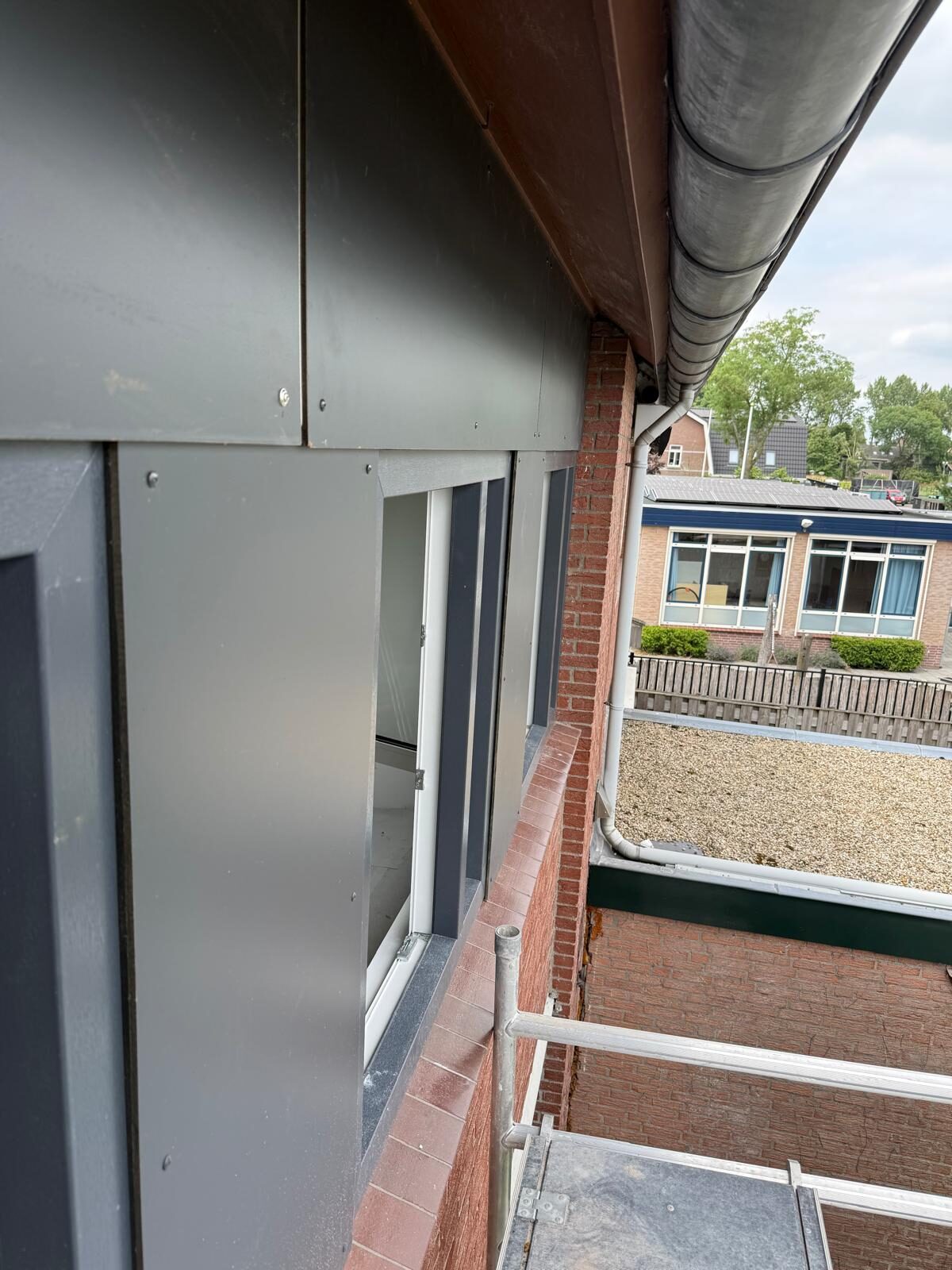
I do not sell brands and I have no dealership, so I have no interest in which material it becomes. What I do is tell you what a material is going to ask of you in a few years, even when that makes the conversation shorter. The facade work that is online at the moment is an upper floor I fitted with new cladding, in board material. If you already know which way it should go, read on about how a clad facade is built up and how it connects.
Featured work
The proof is in and around the house.
Frequently asked questions
Which facade cladding needs the least maintenance?
Plastic, brick slips and zinc, with fibre cement just behind them. Plastic you keep clean with water and a brush, brick slips only ask that you keep an eye on the pointing once they are on, and zinc forms the layer that protects the rest by itself. Wood asks the most, unless you deliberately let it grey out.
Which type of facade cladding lasts the longest?
Zinc, and after that brick slips and fibre cement. But the honest version of this answer is that how long a facade lasts hangs more on the fitting than on the material. A wooden facade on a well ventilated batten frame lasts longer than an expensive material screwed tight against wet brickwork. That is why I put no number of years on it here.
Which facade cladding suits a 1930s house?
Brick slips if you want the character of the facade to stay as it is, and wood if you actually want a contrast on the upper floor or a dormer, say. Fibre cement and zinc look flat and modern, and on a classic facade with a lot of detail that can quickly become too bare. Often the best answer is not the whole facade but one single area of it.
Can I combine two materials on one house?
Yes, and it happens more often than one material across the whole facade. Brickwork on the ground floor with wood or board material on the upper floor is the combination you see most. What it comes down to is the transition between the two faces, because that is where you see straight away whether it was done with care.
Is composite the same as plastic facade cladding?
No. Composite is wood fibre mixed with plastic and looks like wood because of it. Plastic facade cladding is PVC, usually in weatherboards or panels with a click system, and up close that looks like plastic too. Both ask little maintenance, but they do not look the same and they do not cost the same.
Which material do you pick for a dormer or a gable end?
It is exactly on those smaller faces that plastic and zinc come into their own. You are not standing with your nose against them, the area is manageable and maintenance is awkward there because you cannot just reach it. A whole front facade at eye level is a different conversation.
Have this done for you
Would you rather have this work carried out than read about it? Here is what I do exactly.