Advice
What does a landscape gardener cost per hour?
An hourly rate tells you little about garden work, because it does not decide how many hours are needed and it says nothing about what else is in the price. What really makes the figure is taking away the soil and the green waste, the materials, the machine hire and the number of people on the job. So ask about those instead of about a rate.
Updated 2026-09-02
“What does a landscape gardener cost per hour” is one of the first questions people ask about garden work, and almost never the one that gets you any further. An hourly rate says nothing about the number of hours, and with a garden that number is exactly the unknown part. Two landscape gardeners on the same rate can end up far apart on the same garden, and the cheapest is then usually the one who has counted the least. I name no figures on this site, but I do say what the price hangs on, which items belong in a quote, and why the difference between a landscape gardener, a jobbing gardener and a builder weighs heavier than the difference in rate. How I work myself is on laying out gardens and landscaping work.
Why the hourly rate does not set the price
With work indoors I can make a fair estimate of the hours still ahead once the stripping out is done. With garden work I only know that when the spade goes into the ground. Under the topsoil there can be anything: rubble from an old refurbishment, the footing of a fence that once stood there, a compacted layer driven flat by machines, a cable nobody has on a drawing any more. Each of those turns an hour of augering into a day of hand work.
Then there is the shape of your garden. A rectangular area in a garden where you can get to the back with a wheelbarrow is predictable work. Curved edges, an inspection chamber, a tree pit, or a back garden where all the sand has to come in through the hallway are not. The rate can be the same in both gardens while the figure at the bottom is far apart. So a rate without those two things next to it is a number with no meaning.
What belongs in a garden quote
Four items decide whether a garden quote is complete. If one is missing, that quote is not cheaper but incomplete, and the difference comes back later as extra work.
Taking away the soil and the green waste
This is the item that goes missing most often and that is rarely small in a garden. Everything you take out of a garden has to go somewhere: excavated soil, old slabs and block paving, rubble, prunings, a stump with the roots still on it. Soil is heavy, and at the tip green waste is charged by weight or by volume. So ask whether taking it away is included, and whether that covers everything or only the green. Ask as well how it gets out of the garden: can the wheelbarrow go through a gate to the street, or does every load come through the living room? That difference sits entirely in the hours.
The materials, and who orders them
If I supply the materials, you get one price for the whole thing and a wrong order is my problem. If you buy them yourself, I charge only the hours, and that works out well less often than people expect: material ordered too early that has spent a winter outside has twisted, and then the cutting and fitting doubles.
So make sure the quote says which of the two it is. “Materials included” and “materials excluded” are two very different figures under the same description.
Machines and skips
A mini digger, a plate compactor, an auger, a stump grinder and a skip are hired by the day, not by the hour. That has two consequences. Half a day of machine work is rarely half the price. And bundling work pays: if the digger is standing there anyway, that second stump is relatively cheap. If the skip has to stand on the street, with many councils you need a permit for it, and that falls outside the contract sum.
How many people are on the job
The hourly rate of one man and that of a team are not comparable numbers. On heavy groundwork a team gets on faster than the number of people suggests, because lifting and carrying goes easier with two. On precise work, so pruning or cutting paving to fit, that advantage falls away again.
I work on my own. So a big garden takes longer with me than with a firm that has a team, and I say that before we make a plan. It also means the man laying the paving is the same one choosing the planting.
By the hour, by the day or one price for the whole job
Which form is fairest depends on how predictable the job is.
By the hour suits small and unpredictable work: pruning, doing up a border, working through a list of odd jobs. The size is not fixed beforehand, so an estimated total would give false certainty. The same goes for the odd jobs and maintenance indoors.
By the day suits as soon as machines or a skip come into it: I hire those by the day, and then half a day is not half the price.
A fixed price, so one figure for the whole job, suits laying out a garden and paving. Then the risk of nasty surprises in the ground sits with me and not with you. I only come back to it if something turns up that could not be seen beforehand, and then I say so before I carry on rather than afterwards.
Landscape gardener, jobbing gardener or a builder who also does gardens
These three words get used for one another, and nobody stops that: they are not protected titles. In practice they do describe different work, and part of the difference in rate sits there.
A jobbing gardener mostly does maintenance, often on a fixed round: hedges, pruning, weeds, keeping borders in order. Recurring work, almost always by the hour or by the visit.
A landscape gardener does the laying out as well: groundwork, paving, planting plans, sometimes design. Bigger work, with materials and machines involved, and it goes on a fixed price more often than by the hour.
A builder who also does gardens has the structural side on top of that. A patio that falls away from the wall of the house, a foundation under a canopy, a gate that has to hang square, a threshold that meets the paving. That is a different trade from planting, and you only notice it when it goes wrong: a patio that falls towards the house is a garden problem that turns into a building problem.
That last category is where I sit, with over twenty years in construction and seven years of agronomy behind it. The soil and the planting on one side, the structure and the join with the house on the other. If a canopy, a gate or a shed comes into it, that falls under carpentry and fitting, but it is the same day and the same man. If the garden is upside down because an extension or an annexe comes first, we plan putting the garden right after that.
How I go about it
Send me a few photos of the garden, preferably one from an upstairs window as well, because from there I can see the shape better than from ground level. I come and look, measure up and dig a hole, and only then do I put something on paper. That quote says item by item what I am going to do, what I supply and where the uncertainty sits. Tucking that uncertainty away in one round figure is easy, right up to the moment the spade hits rubble. If you want to put your garden to me, get in touch.
Featured work
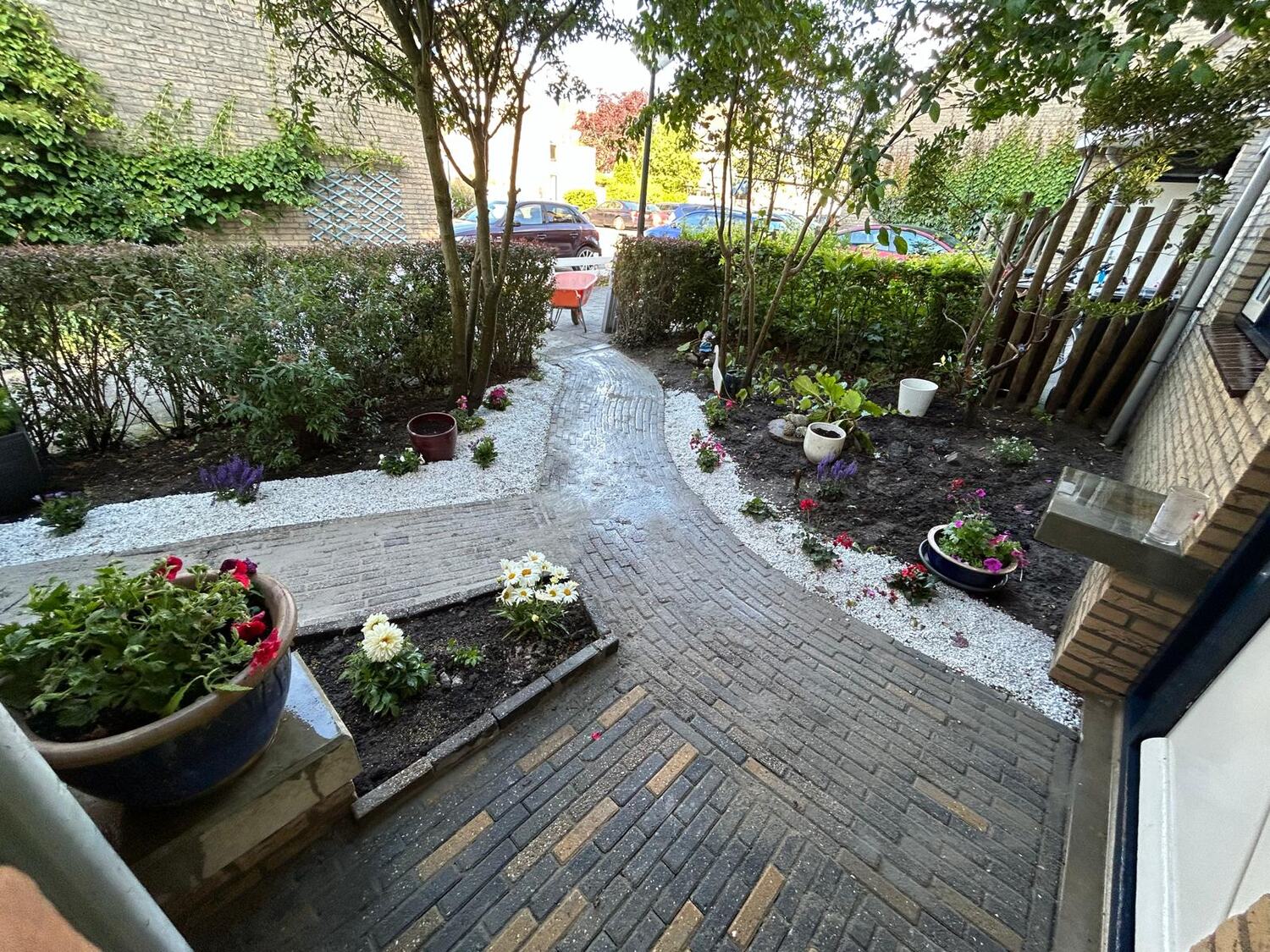
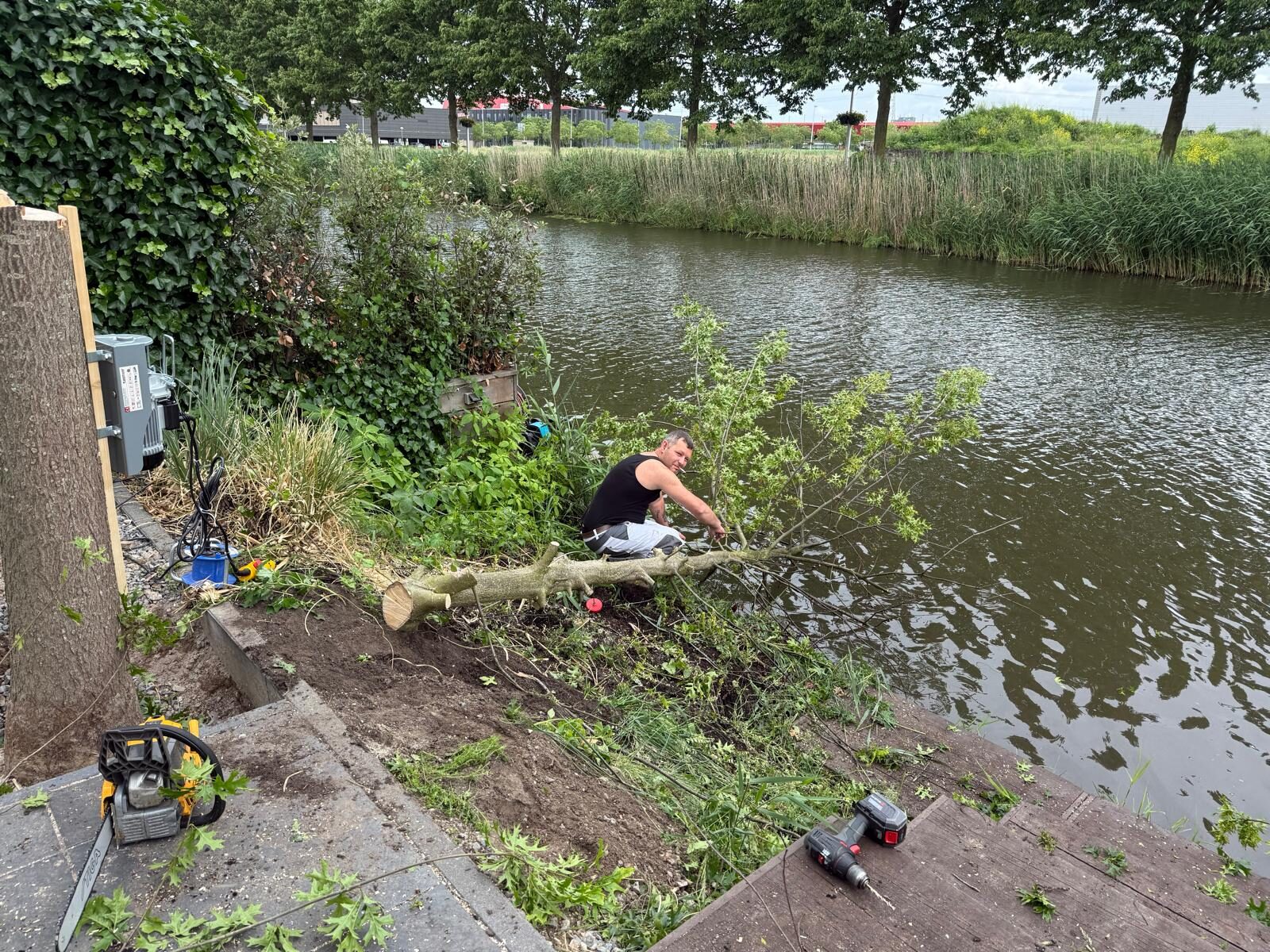
The proof is in and around the house.

Frequently asked questions
Why is there no hourly rate on your site?
Because a rate without your garden next to it predicts nothing. With garden work the number of hours is the unknown part, not the price per hour. What I do instead is come round, measure up, dig a hole and then put on paper item by item what I am going to do. Then you know where you stand, and that is something else than knowing a number.
Is a landscape gardener with a lower hourly rate cheaper?
Not by itself. A lower rate with more hours comes out higher, and a rate without the waste removal or the materials in it is being compared with a rate that has them in. So first put side by side what the two quotes say, and only after that what is at the bottom of them.
What belongs in a garden quote?
At least four things. Who takes away the soil, the old paving and the green waste. Whether the materials are supplied or you buy them yourself. Whether the machines and any skip are counted in. And what happens if something turns up under the ground that does not belong there. If one of those four is missing, the quote is not cheaper but incomplete.
What is the difference between a landscape gardener, a jobbing gardener and a builder?
They are not protected titles, so anyone may call themselves that. In practice a jobbing gardener mostly does recurring maintenance, a landscape gardener does the laying out with groundwork and planting as well, and a builder who also does gardens has the structural side on top: the falls, a foundation under a canopy and the join with the house. That explains part of the difference in rate.
Do you charge by the hour or by the job?
All three forms come up. By the hour on small and unpredictable work such as pruning or doing up a border. By the day as soon as machines or a skip come into it, because I hire those by the day. And on laying out a garden I prefer a fixed price: one figure for the whole job, so a nasty surprise in the ground is my risk and not yours.
Why is taking the waste away such a big item in garden work?
Because everything you take out of a garden is heavy and takes up room. Excavated soil, old slabs, rubble, prunings, a stump with the roots still on it. At the tip that counts by weight or by volume, and in the garden itself what counts most is how it gets to the street. If every wheelbarrow has to go through the living room or through a narrow gate, the difference sits entirely in the hours.
Am I better off buying the materials myself?
Less often than people think. Material ordered too early that has spent a winter outside has twisted, and then the cutting and fitting doubles. Getting the quantity wrong is your risk too: too little means an extra trip, too much means something you do not take back. If I supply it, that is my problem.
Have this done for you
Would you rather have this work carried out than read about it? Here is what I do exactly.